
Key takeaways
Sustainable jewelry packaging comes down to 4 components: the box wrap, the insert, the pouch, and the tissue touching the metal.
- 01A rigid box's exterior wrap and lamination decide its recyclability, not the board underneath.
- 02Molded pulp and die-cut cardboard inserts are the recyclable alternatives to foam.
- 03Compostable film lamination is built for industrial composting, not for paper recycling.
- 04Tissue touching silver is specified on a tarnish test, not on recycled content.
- 05Ask a supplier for an FSC chain-of-custody certificate number, not an assurance.
Last updated October 2026.
Jewelry brands are precise about their metals yet vague about their boxes. Pandora crafts every piece from 100% recycled silver and gold. Astrid & Miyu describes its box as a "100% recyclable jewellery box", without saying what that covers or who assessed it. The metal gets a number and the box gets a claim with nothing behind it.
That gap is worth closing, because in jewelry the box is part of what the customer paid for. A ring is small, expensive, and usually bought as a gift, so the pack has to do presentation work that a shipping box never does. It is also why swapping one material for a greener one does not answer the question on its own.
This guide covers sustainable jewelry packaging one component at a time. For each part of the pack it says what the part is made of, which choices cancel out the others, and what to ask a supplier to prove.
What Counts as Eco Friendly Jewelry Packaging?
A jewelry pack is 3 separate decisions, not one object. Whether the finished pack can be recycled usually comes down to two of them, and they are the two that rarely appear on a specification sheet.
- The shell. The rigid box or folding carton, plus the paper wrap and the finish applied to the outside of it.
- The insert. Whatever holds the piece in position: cardboard, molded pulp, foam, or a vacuum-formed plastic tray.
- The pouch and tissue. The soft parts that touch the metal directly.
Most briefs specify eco-friendly packaging for jewelry at the board level and stop there. A brand asks for recycled board, then orders a metallic laminated wrap to go over the top of it. Every line on the specification sheet is correct, but now the finished box cannot be recycled.
Which Part of a Jewelry Box Decides Whether It Can Be Recycled?
The wrap and the finish decide it, almost every time.
A rigid jewelry box is built from chipboard, the dense gray board that gives a setup box its structure. A printed paper wrap is glued over the outside of it. The board underneath is rarely the problem. The layer glued on top of it usually is, and that layer decides the outcome for the whole box.
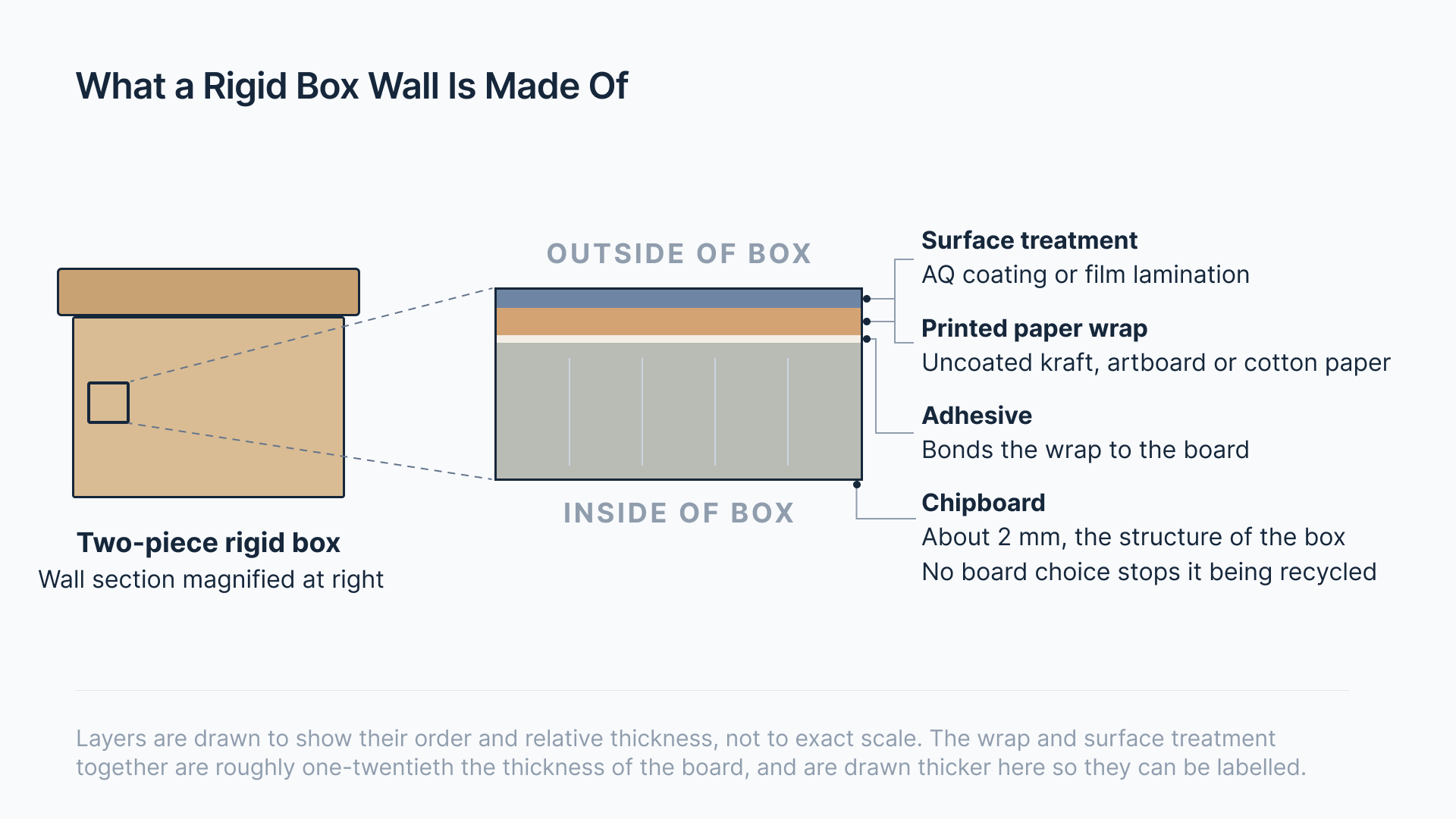

The whole right-hand column comes down to one thing. Recycling a paper box means pulping it, and the fiber has to separate in water. Anything that will not separate gets screened out, and depending on the recycler it can take the box with it.
Compostable lamination belongs on the right, and this catches people out. A compostable film is built to break down in an industrial composter, which is heat and time. A pulper is neither. The film behaves like any other plastic in there, so a compostable laminate does not buy back the recyclability that film lamination costs you. If a supplier tells you otherwise, ask for the recyclability test report for that exact construction.
These swaps cost you metallic shine, and they cost you foil stamping. They do not cost you texture, depth, or the weight of the box in the hand, which is where a rigid box does most of its presentation work.
The Insert Is Where the Plastic Is
Molded pulp and die-cut cardboard are the two replacements that work in most cases. You can specify recycled board, an uncoated wrap, and a kraft mailer, and still hand a customer a pack with a block of polyurethane sitting inside it. Table 1 settles whether the box can be recycled. The insert settles whether the pack contains plastic at all.
Inserts come in 4 constructions. Cardboard and molded pulp are both paper. Foam comes in polyurethane, EVA, or polyethylene. A vacuum-formed tray is plastic. Two of the 4 are paper, which makes the insert one of the easier components to change.
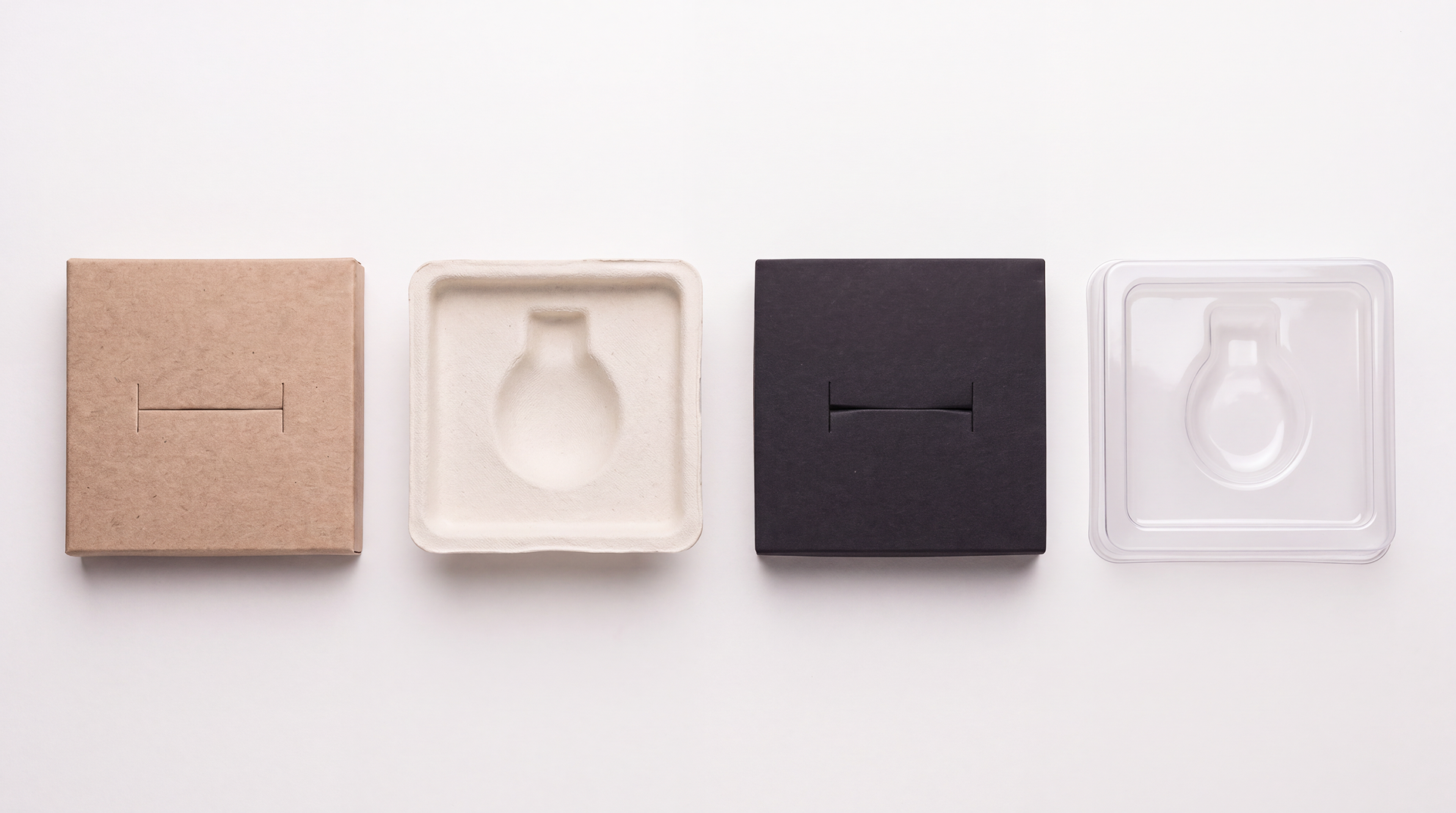
Molded pulp can be produced from post-consumer waste pulp, so one component ends up both recycled and recyclable. A die-cut cardboard platform is lighter still, and it suits flat pieces such as pendants and earrings.
Foam still has a place, and it is worth saying so. For a delicate piece, or one with a fragile setting, a fitted foam cushion holds it better than paper does. Swapping in a paper insert that lets the piece move around is a downgrade, even if it looks like an improvement on the specification sheet.
Pandora is the clearest published example of taking plastic out of a jewelry pack at scale. It cut the plastic content in its jewelry boxes by more than 75% and took the plastic out of its carrier bags, which are now paper. Against its previous boxes that reduced greenhouse gas emissions by more than 60%, an expected saving of about 3,600 metric tons of CO₂ a year, announced on 29 September 2021 with rollout continuing into 2022 (Packaging Gateway).
One caution on biodegradable jewelry packaging. A material that breaks down in an industrial composting facility behaves differently in a landfill, and not every customer has access to industrial composting. A claim built on that infrastructure depends on whether your customer happens to have it. Specifying something recyclable through a collection stream that already exists is the safer route.
Can Recycled Packaging Protect Silver From Tarnishing?
Not automatically, and this is the one component where a recycled-content specification can damage the product it is protecting. Whether tissue tarnishes silver is decided by its lignin and sulfur content. A recycled-content requirement does not test for either one. So the "100% recycled" line most briefs run across the whole pack says nothing useful about the one sheet touching the metal.
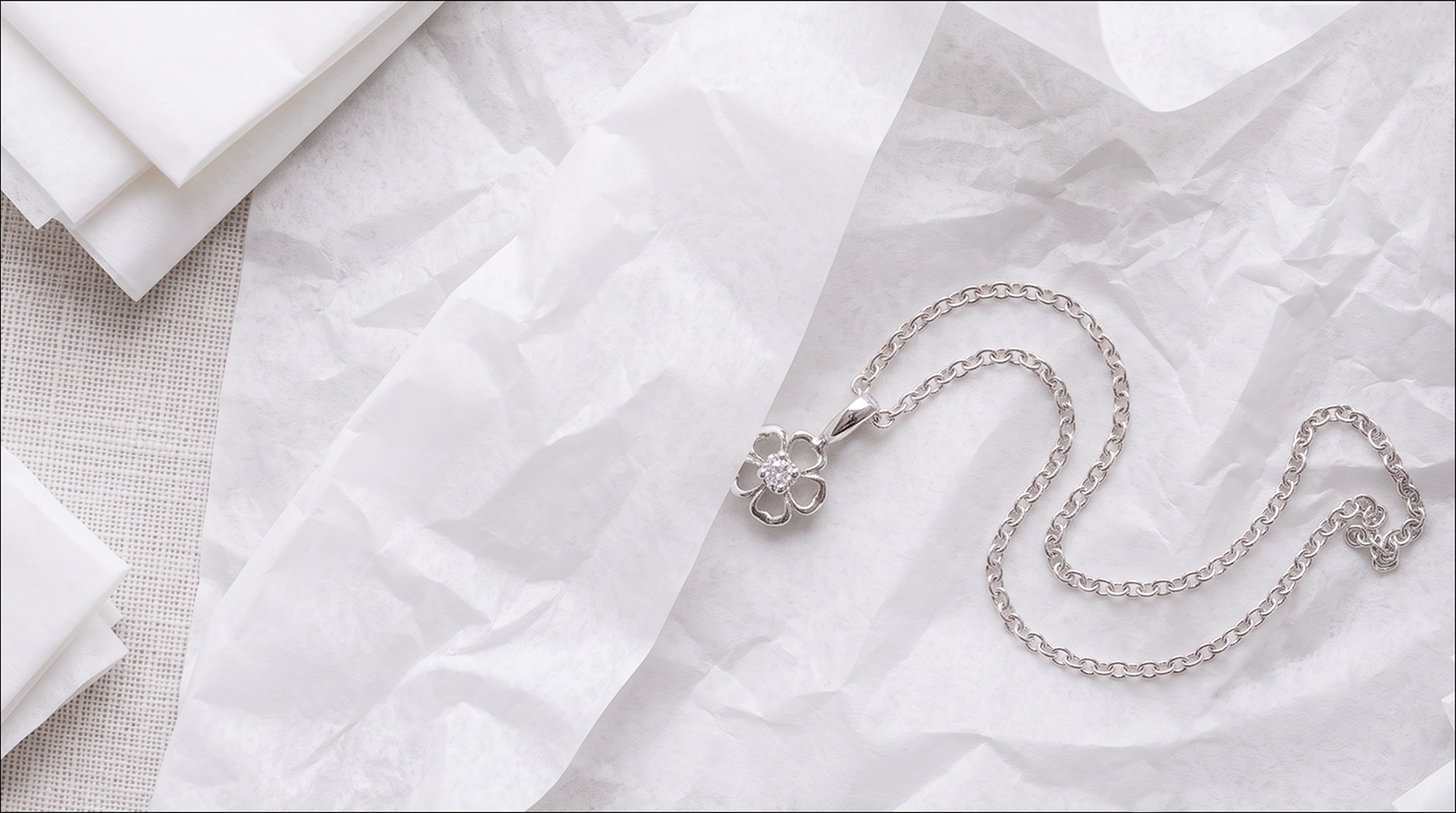
Silver tarnishes when hydrogen sulfide in the surrounding air reaches the metal. Anti-tarnish paper works chemically rather than as a barrier: it absorbs the gas before it gets to the surface, and some grades also release inhibitors that settle on the metal itself (Cortec Corporation).
Whether a given tissue does that is settled by TAPPI T 444, the silver tarnishing test for paper and paperboard, published by the Technical Association of the Pulp and Paper Industry. The report describes what tarnish, if any, the paper caused, and suppliers summarize a clean result as having passed. Ask to see it rather than taking the summary.
The number that goes with it comes from a second test, TAPPI T 406, which measures reducible sulfur. Nashville Wraps publishes both figures for its unbuffered anti-tarnish tissue: no detectable residual lignin, and less than 0.0008% reducible sulfur (Nashville Wraps). Ask for that grade by name. The same supplier also sells a buffered archival tissue at pH 8.5 to 9, which is a different product and not the one you want against silver.
So write the specification in two halves. Put the recycled-content requirement on the box, the wrap, the insert, and the mailer. Specify the tissue and the pouch liner on test performance instead, and ask for the test report. That is the whole fix, and it costs nothing but a line on a purchase order.
What Do Major Jewelry Brands Disclose About Sustainable Jewelry Packaging?
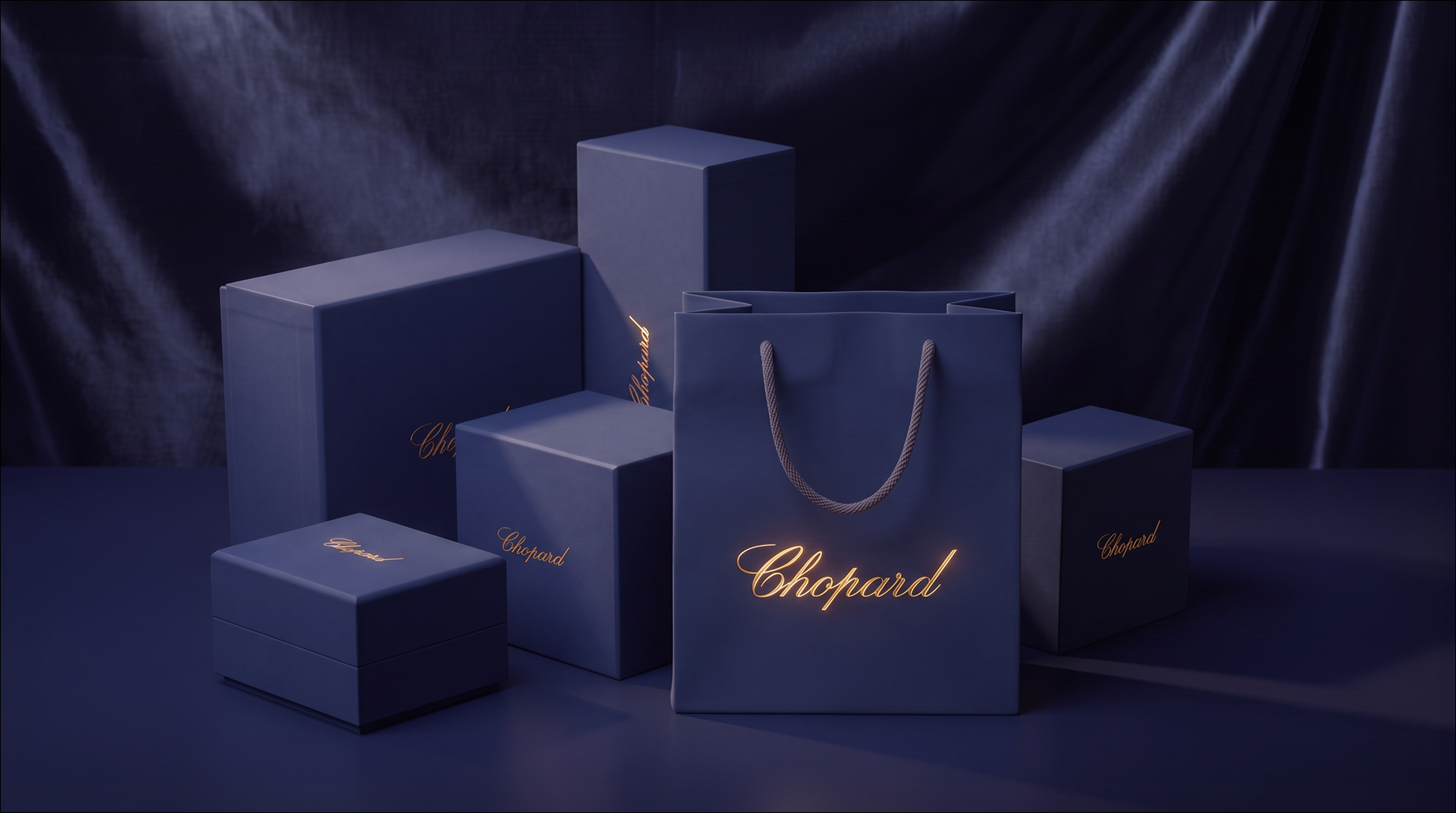
Chopard gives more component-level detail than any of the other 3 brands in this guide. Its published list covers FSC-certified paper for shopping bags and wrapping, walnut boxes in FSC-certified wood, recycled paper and cardboard, stainless steel hinges, and water-based varnish and glue (all of it set out on Chopard's own environmental responsibility page, and reported in Solitaire). Naming the adhesive is the unusual part, because most brands never mention adhesive at all.
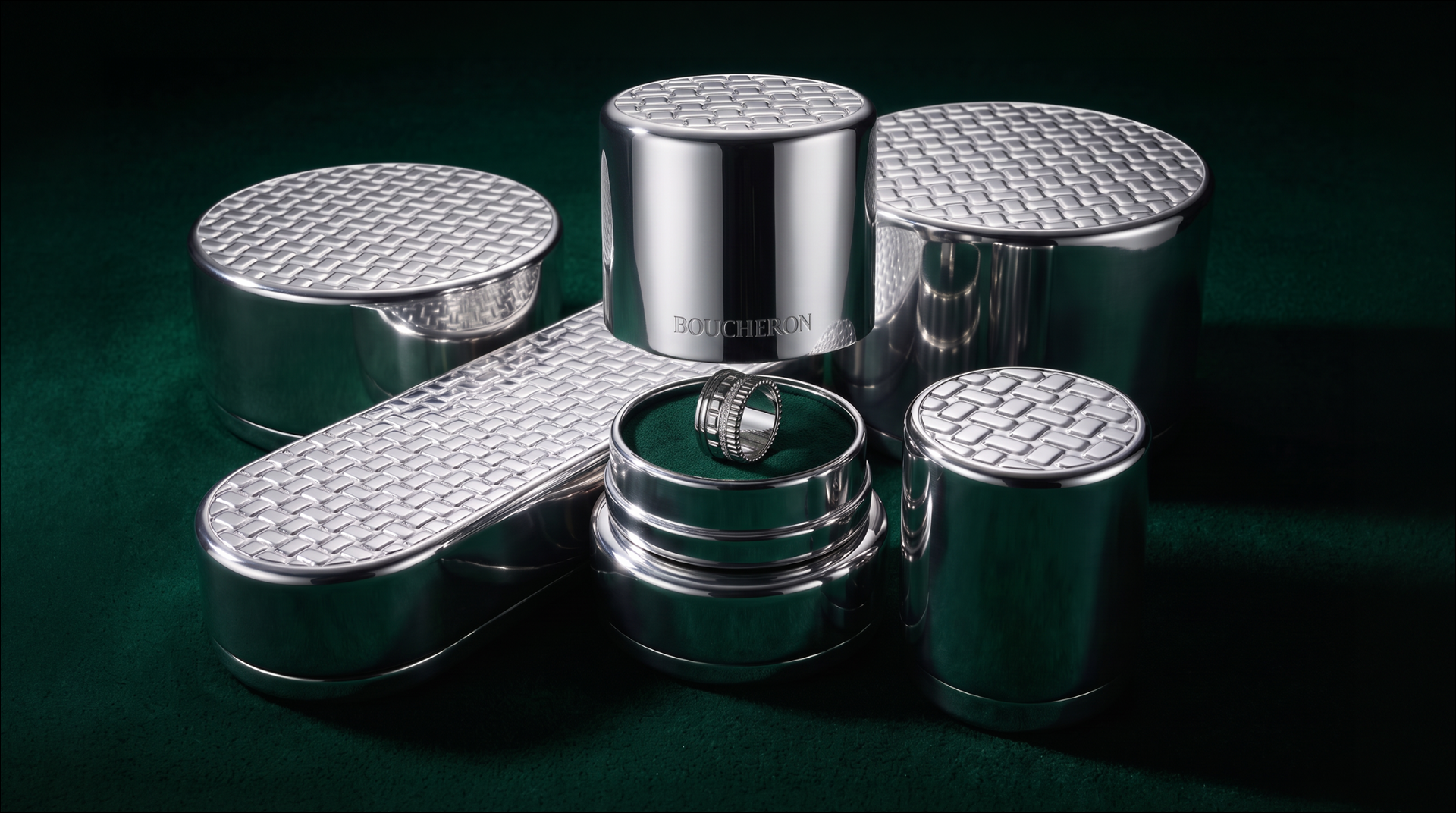
Boucheron changed the substrate instead. Its cases are now made from aluminum and wool felt only, in a collection of 7 boxes replacing 12 (Solitaire; the cases are pictured on Boucheron's own page).
If you are working out how to customize jewelry packaging without giving up the finish, price two substitutions first: AQ coating in place of film lamination, and a blind emboss in place of foil. Both work on sustainable jewelry boxes in a two-piece construction and on the slimmer eco-friendly jewelry boxes built as folding cartons.
What Documentation Should a Sustainable Jewelry Packaging Supplier Provide?
4 documents. They are the difference between a supplier who can support your claims and one who can only repeat them back to you.
- An FSC chain-of-custody certificate, with the certificate number, from the company that converts your board. A statement that a mill somewhere is certified is not the same thing. Our guide to FSC certified packaging covers what the certificate does and does not prove.
- A recycled-content declaration, as a percentage, split post-consumer and pre-consumer, per component.
- A tarnish test report against TAPPI T 444 for anything touching silver.
- A recyclability assessment for the finished pack, not one per component. This is Table 1 in document form, and it is the one you are least likely to be offered without asking. Chain of custody proves where the fiber came from. It says nothing about whether the assembled box can be recycled.
Ask for all 4 at the quotation stage, whether you are choosing packaging for an online jewelry shop or buying eco friendly jewelry packaging wholesale.
Where PakFactory Fits
We make the components this guide covers: rigid setup boxes, folding cartons, box inserts in cardboard, molded pulp, and foam, cotton and canvas pouches, acid-free tissue paper, and paper and kraft mailer bags. Our vetted manufacturing network holds FSC chain-of-custody and SGS certifications. It can also produce to SFI, the North American forest-certification scheme, or PEFC, the international umbrella covering regional schemes, where a program requires them. So a pack can be specified part by part, with the documentation above produced for each one.
Bring your current pack and the claims you need it to support. Talk to our team about a specification review, and request a sample of the alternative before you commit to a run. Our custom jewelry and accessories packaging range covers the boxes, inserts, and mailers.
Sources
- Chopard's FSC-certified paper, walnut boxes, water-based varnish and glue, recycled paper and cardboard, and stainless steel hinges: Chopard, environmental responsibility.
- Boucheron's aluminum and wool felt cases, the 12 formats and 11 materials they replaced, the collection of 7 boxes, and the fourfold weight reduction: Boucheron, "No Pack Is the New Pack".
- Chopard's and Boucheron's packaging changes: Solitaire, Gem & Jewellery Export Promotion Council, "Why Global Jewellery Brands Are Dialling Down on Opulent Packaging".
- Pandora's plastic reduction, emissions figures, packaging paper description, and announcement date: Packaging Gateway, "Pandora launches plastic-free packaging in stores and online", with the 29 September 2021 announcement confirmed by ESG Today. These figures appear in trade coverage from 2021 and are not published on Pandora's current packaging page.
- Pandora's recycled silver and gold: Pandora Group, "Pandora shifts to recycled silver and gold".
- Astrid & Miyu's "100% recyclable jewellery box" and reusable suedette pouch: Astrid & Miyu, sustainability; the polishing cloth and care booklet on 14k and 9k gold pieces: Astrid & Miyu US, sustainability.
- Anti-tarnish paper and the hydrogen sulfide mechanism: Cortec Corporation, anti-tarnish paper.
- The TAPPI T 444 and T 406 test methods: TAPPI T 444, silver tarnishing by paper and paperboard and TAPPI T 406, reducible sulfur in paper and paperboard.
- Nashville Wraps' lignin and reducible-sulfur figures: Nashville Wraps, archival tissue information.
- Biodegradable and compostable film in paper recycling: UK Government, Recycling Assessment Methodology.
Frequently asked questions
Written by
5+ years in content strategy — building packaging case studies, guides, and blogs.