Key takeaways
To prove your packaging is PFAS-free, pair a signed supplier declaration with an accredited-lab test, and match the certificate to your market's limit.
- 01As the importer, your brand carries the PFAS liability, not the overseas factory.
- 02A supplier's "PFAS-free" claim isn't proof on its own; a lab test is.
- 03Screen with a low-cost total organic fluorine (TOF) test; add a targeted LC-MS/MS test only for the EU or high results.
- 04Test at an ISO/IEC 17025 lab that covers PFAS and your material type.
- 05Match the certification to your market: under 50 ppm TOF for most (per NSF 537), 25 ppb per substance for the EU.
- 06A valid Certificate of Analysis names the method, result, and accredited lab; keep records on file — five years is a sensible default.
Our guide to the 2026 PFAS packaging bans covered what's changing and why it lands on importers. This one is the practical follow-up: how do you actually prove your packaging is PFAS-free — and do you have to manage all of it yourself? It answers both, and shows where PakFactory can take the job off your plate.
PFAS (per- and polyfluoroalkyl substances, the "forever chemicals") are a large family of synthetic chemicals used since the 1940s to make products resist grease, water, and heat. They barely break down, so they build up in people and the environment over time, which is why regulators are restricting them in food packaging (US EPA: PFAS Explained).
How Do You Know If Your Packaging Contains PFAS?
PFAS turn up most in grease- and water-resistant paper and fiber food packaging, where they're added to stop oil and moisture soaking through. If your packaging is fiber-based and touches greasy or wet food, treat it as at-risk until it's tested (NIH).
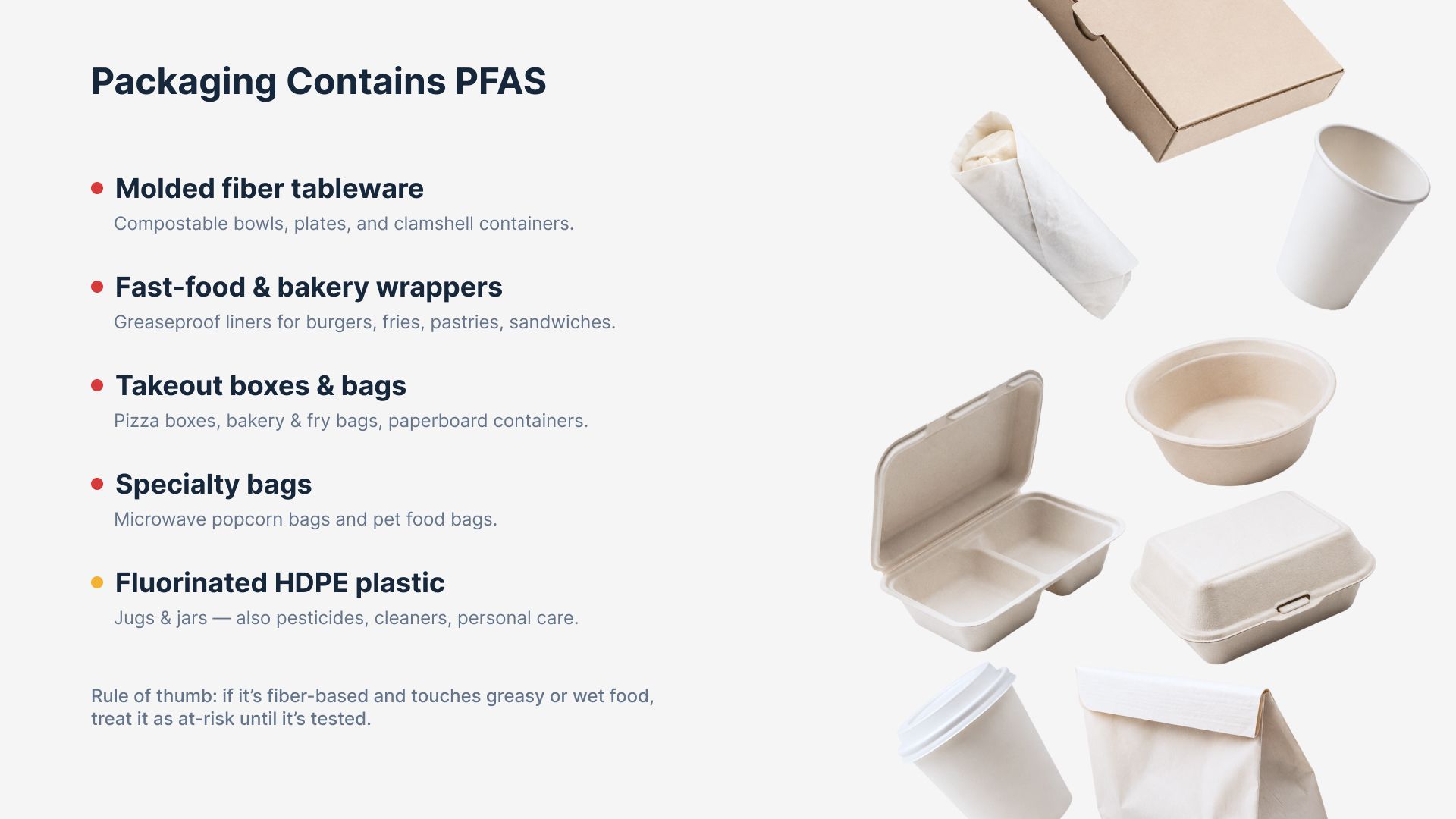
The usual suspects (fiber-based food packaging):
- Molded fiber tableware: compostable bowls, plates, and clamshell containers.
- Fast-food and bakery wrappers: greaseproof liners for burgers, fries, pastries, and sandwiches.
- Takeout boxes and bags: pizza boxes, bakery bags, french-fry bags, and paperboard takeout containers.
- Specialty bags: microwave popcorn bags and pet food bags.
Beyond fiber — treated plastic containers. Fluorinated HDPE jugs and jars (plastic treated with fluorine gas for a stronger barrier) can also form and leach PFAS, and these are used well past food, in pesticides, household cleaners, and personal-care products (EPA). So while the risk is concentrated in food-contact fiber packaging, a fluorine-treated plastic container is worth checking too.
Note the timing: in 2024 the FDA secured a market phase-out of grease-proofing PFAS in new US food packaging, with a June 30, 2025 compliance date to exhaust existing paper-packaging stock (FDA; Morgan Lewis). Even so, legacy stock, imports, and non-food fluorinated plastics mean verifying your own SKUs is still on you.

The Step-by-Step PFAS Testing Process for Brands
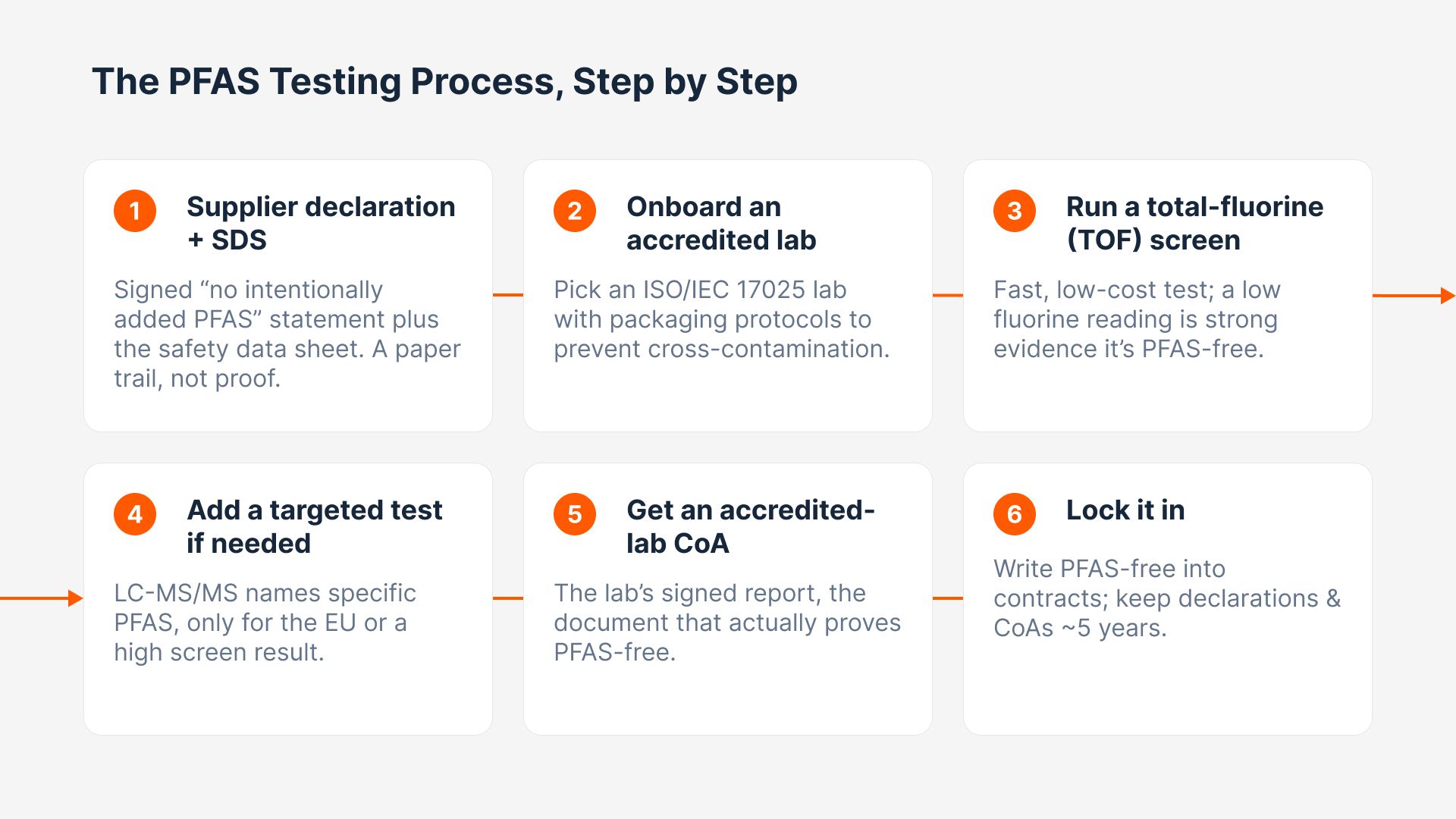
The process is a short, repeatable sequence that moves your packaging from "unverified" to "documented." It works whether you manage one supplier or many.
- Get a supplier declaration and safety data sheet (SDS). Ask each supplier for a signed statement of no intentionally added PFAS, plus the SDS, the standard document listing what is in a material. This is your paper trail, not your proof.
- Onboard an accredited laboratory. Before sending out samples, select a third-party laboratory certified in consumer product testing (such as ISO/IEC 17025 accreditation). Ensure they have specific protocols for handling packaging materials to prevent cross-contamination during transit and testing.
- Run a total organic fluorine (TOF) screen. TOF is a fast, relatively inexpensive lab test that measures how much fluorine is in the material; because PFAS are the usual reason packaging would contain fluorine, a low reading is strong evidence it is PFAS-free (Measurlabs).
- Add a targeted PFAS test only if you need it. If you sell into a market with per-substance limits (the EU) or the screen comes back high, run a targeted analysis (LC-MS/MS) that names and measures specific PFAS (Bureau Veritas).
- Get an accredited-lab Certificate of Analysis (CoA). The CoA is the lab's signed report of what was tested, how, and what was found. It is the document that proves your packaging is PFAS-free, matched to the rule of the market you sell into.
- Lock it in. Write PFAS-free into your supplier contracts and keep the declarations, CoAs, and test reports on file. As a best-practice default, hold them for at least five years so you can produce proof for a customs check, audit, or regulator on demand.
Total Fluorine vs. Targeted PFAS Testing: Which Do You Need?
Use the two tests for different jobs — pick by where you sell and what your screen shows:
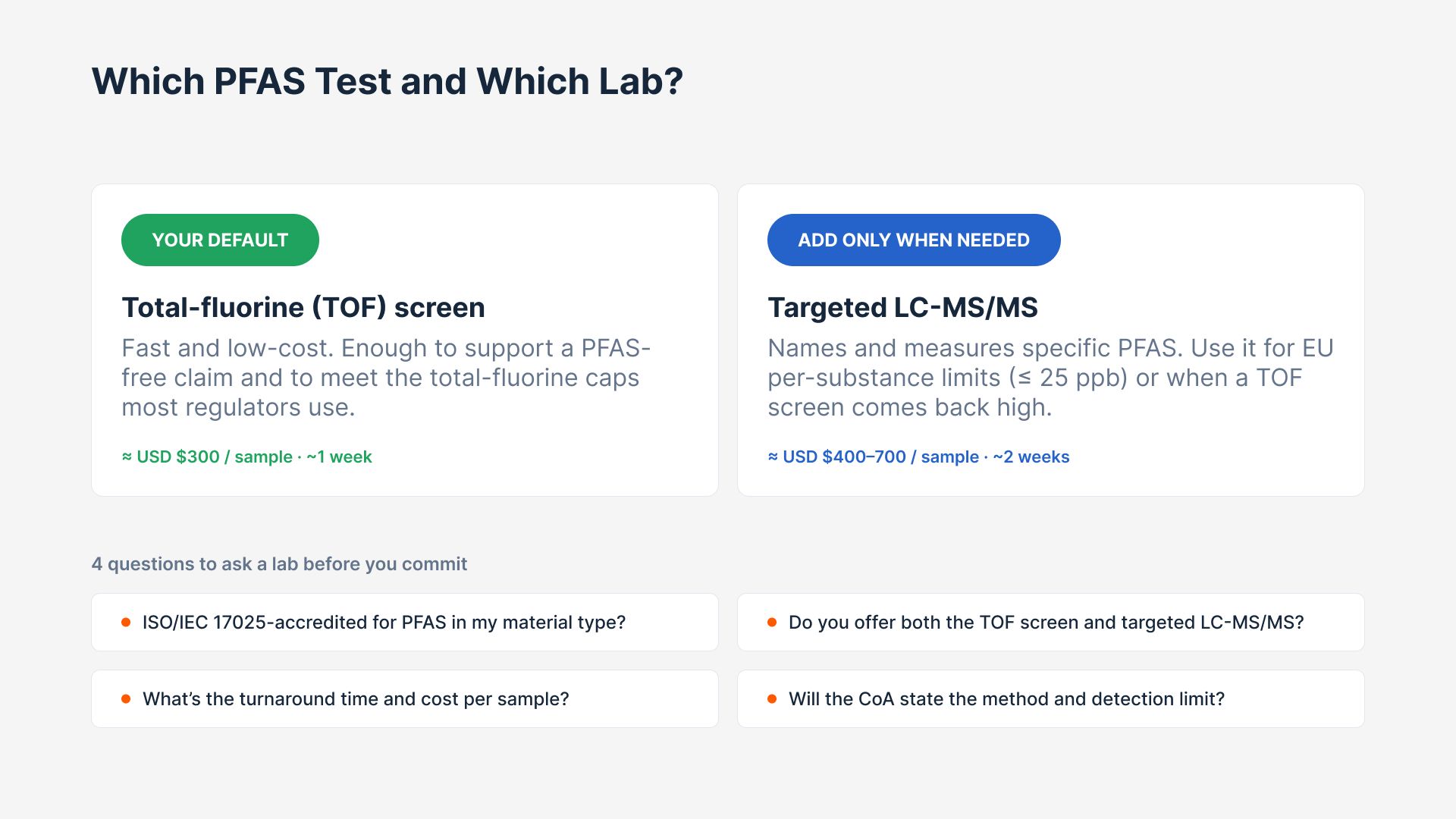
- Total organic fluorine (TOF) screen — your default. Fast and low-cost; enough to support a PFAS-free claim for most packaging and to meet the total-fluorine caps many regulators use.
- Targeted LC-MS/MS test — add it only when you have to. Namely, if you sell into a per-substance-limit market like the EU (≤25 ppb per substance), or if a TOF screen comes back high and you need to confirm whether that fluorine is actually PFAS.
The technical details of how each test works live in the FAQ, so you don't have to be a chemist to make the call.
Where to Test for PFAS: Choosing an Accredited Lab
Use a laboratory accredited to ISO/IEC 17025, the international standard that certifies a lab is technically competent and its results are trustworthy (ISO). Then confirm two things: that PFAS testing and your specific material type (paper and board, coatings, or plastics) are both inside that accreditation. Established third-party labs include Eurofins, SGS, Intertek, Bureau Veritas, UL, and NSF.
A short checklist to send a lab before you commit:
- Are you accredited to ISO/IEC 17025 for PFAS in my material type?
- Do you offer both the total organic fluorine screen and targeted LC-MS/MS?
- What is the turnaround time and cost per sample?
- Will the Certificate of Analysis state the method and detection limit?
This is also the step where you do not have to go it alone: PakFactory coordinates the right test with the right accredited lab on your behalf (more below).
Recognized PFAS-Free Certifications and What Their Thresholds Mean
Here is the honest read before the numbers: there is no single, universal "PFAS-free" stamp. The credible programs all land on the same idea, a total-organic-fluorine limit plus "no intentionally added PFAS," so the real question is not which logo to chase, it is which limit your market and your claim require.
For most food packaging, staying under roughly 50 ppm total organic fluorine with no intentionally added PFAS is the practical bar. If you sell into the EU, you need more: a targeted, accredited-lab test showing 25 ppb or less per substance. And a bare "PFAS-free" label with no threshold or test behind it is not proof of anything. Pick the certification that matches where you sell, and always ask for the Certificate of Analysis.
The programs, from strictest limit to most permissive, for reference:
How to Read a PFAS Certificate of Analysis
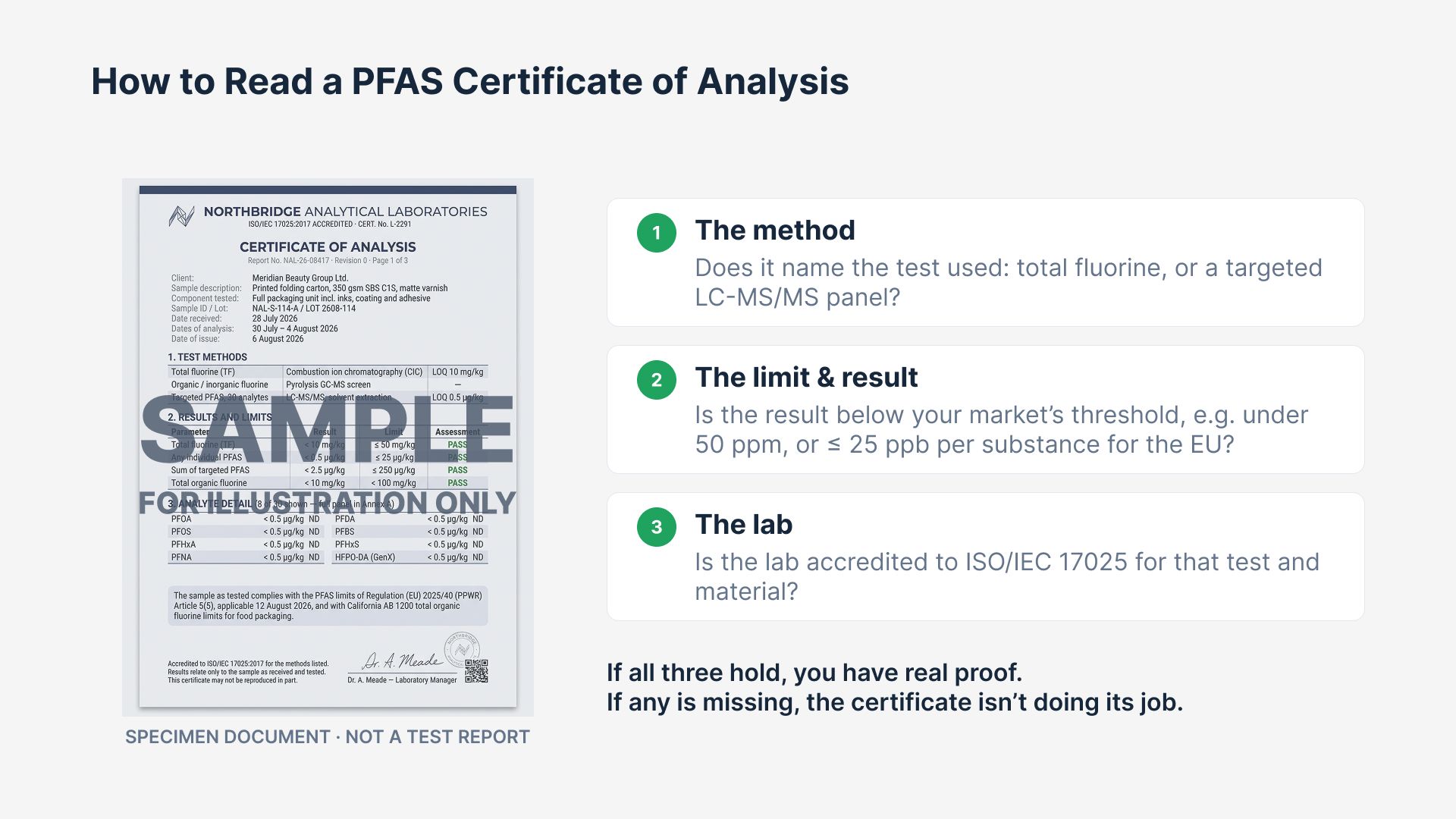
A Certificate of Analysis can look intimidating, but you only need to check three things:
- The method. Does it name the test used (total organic fluorine, or a targeted LC-MS/MS panel)?
- The limit and result. Is the result below the threshold your market or certification requires (for example, under 50 ppm, or 25 ppb per substance for the EU)?
- The lab. Is the lab accredited to ISO/IEC 17025 for that test and material?
If all three hold, you have real proof. If any is missing, the certificate is not doing its job.
How PakFactory Gets Your Packaging Tested, Certified, and PFAS-Free
You do not have to run this gauntlet alone, and you should not have to become a testing expert to sell compliant packaging. This is the part PakFactory is built to carry, and it comes down to two things working together: packaging that starts compliant, and the documentation that proves it.
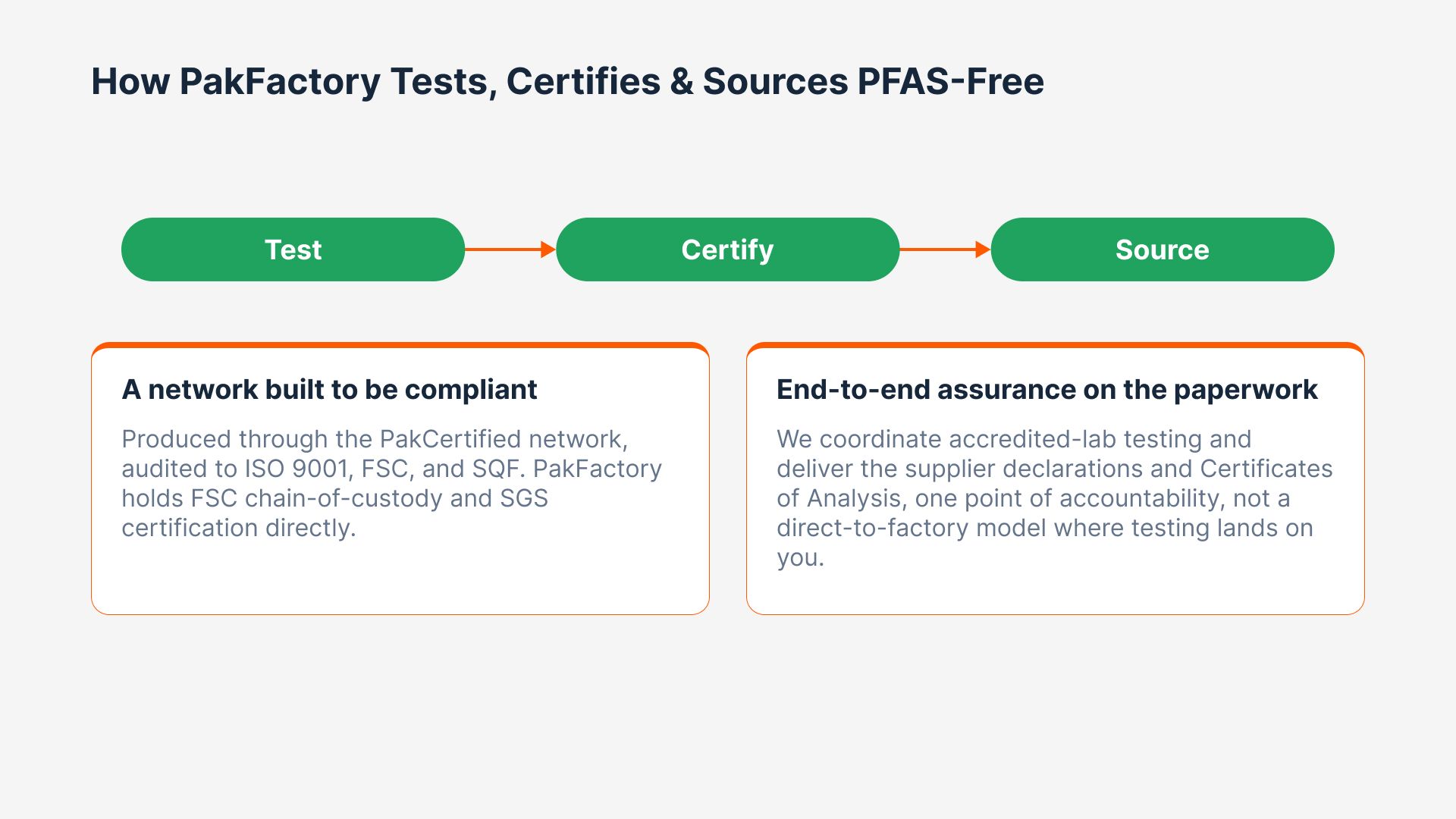
A network built to be compliant.
Your packaging is produced through the PakCertified global network, a vetted set of manufacturing partners, each audited against global standards including ISO 9001, FSC, and SQF, with quality enforced at the network level rather than left to each individual factory.
End-to-end assurance on the paperwork.
PakFactory coordinates accredited-lab testing and supplies the resulting documentation, so you get the supplier declarations and Certificates of Analysis without chasing labs or managing the process yourself.
Ready to check your exposure?
Talk to our team about testing and certifying your packaging PFAS-free, and we will map your at-risk SKUs, match each to a compliant material, and line up the documentation you need for Canada, the EU, and the US.
Sources
- PFAS overview and carbon-fluorine bonds: US EPA — PFAS Explained.
- Accredited-lab standard: ISO/IEC 17025.
- Testing methods (TOF, targeted LC-MS/MS): Measurlabs; Bureau Veritas.
- Certification thresholds: BPI, NSF 537, UL Solutions, Intertek PFAS-Free.
- Paper-based food-contact materials method comparison: PubMed.
- Regulations: EU Packaging and Packaging Waste Regulation (PPWR) — Regulation (EU) 2025/40 (PFAS limits apply 12 Aug 2026).
- PFAS in food packaging (why and where): NIH — PFAS in Food Packaging: A Hot, Greasy Exposure.
- FDA grease-proofing phase-out (2024): FDA phase-out summary.
- PFAS in fluorinated plastic containers (non-food): US EPA — PFAS in Pesticide and Other Packaging; EDF — Beyond paper.
- NSF — Introduces PFAS-Free Certification (NSF 537 definition)
- FDA — Market Phase-Out of Grease-Proofing Substances Containing PFAS
Frequently asked questions
Written by
5+ years in content strategy — building packaging case studies, guides, and blogs.