Key takeaways
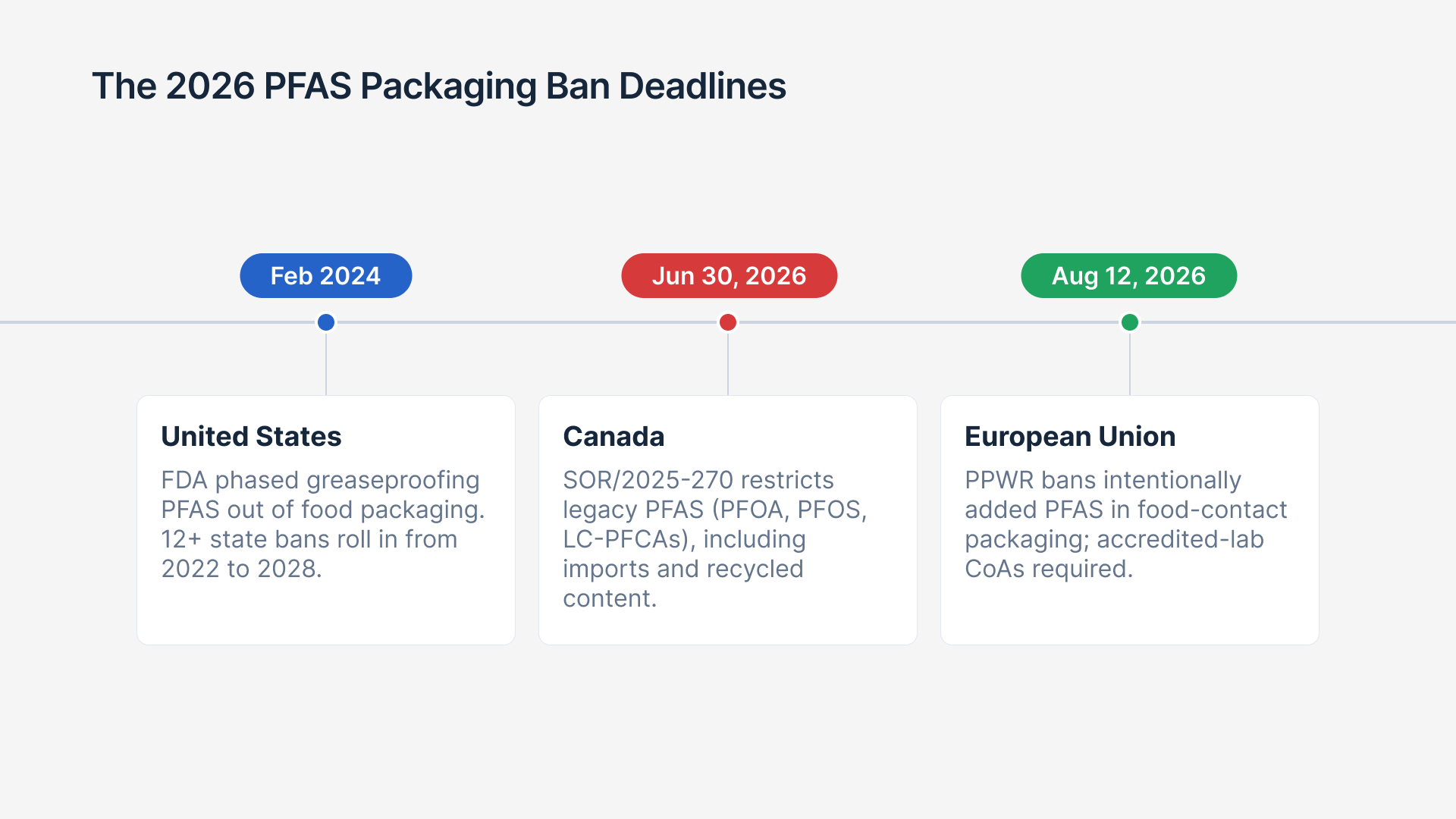
- 01The 2026 PFAS rules are landing on staggered dates: Canada's is now in force (as of June 30, 2026), the EU's applies from August 12, 2026, and the US is already covered, through the FDA's 2024 phase-out plus more than a dozen state laws.
- 02These are import bans. The brand placing the product on the market is liable, not the overseas factory, even when the brand did not know PFAS were present.
- 03"Made overseas" defaults to unverified. A brand sourcing direct from a factory usually cannot audit the coatings or obtain accredited lab proof, so it carries the risk blind.
- 04To get compliant: map the SKUs with grease or water coatings, secure written no-PFAS supplier declarations, test at an ISO/IEC 17025-accredited lab, and keep records for 5 years. The EU requires Certificates of Analysis.
- 05PFAS-free routes exist today, including aqueous coatings, PLA and PLA+PBAT films, molded pulp, paperboard, and food-grade tinplate, supplied with the documentation that proves compliance.
Last updated August 2026.
PFAS are in everything from cookware and clothing to cosmetics, firefighting foam, and drinking water. This guide focuses on just one corner of that landscape: the food and beverage packaging the 2026 rules put on importers' desks. It is written for the operations, compliance, and procurement leads who will be asked what is actually in the box, and it covers which rules apply in your markets, who carries the responsibility, and how to verify and source compliant packaging.

What Are PFAS? And Why Were They Used in Food Packaging?
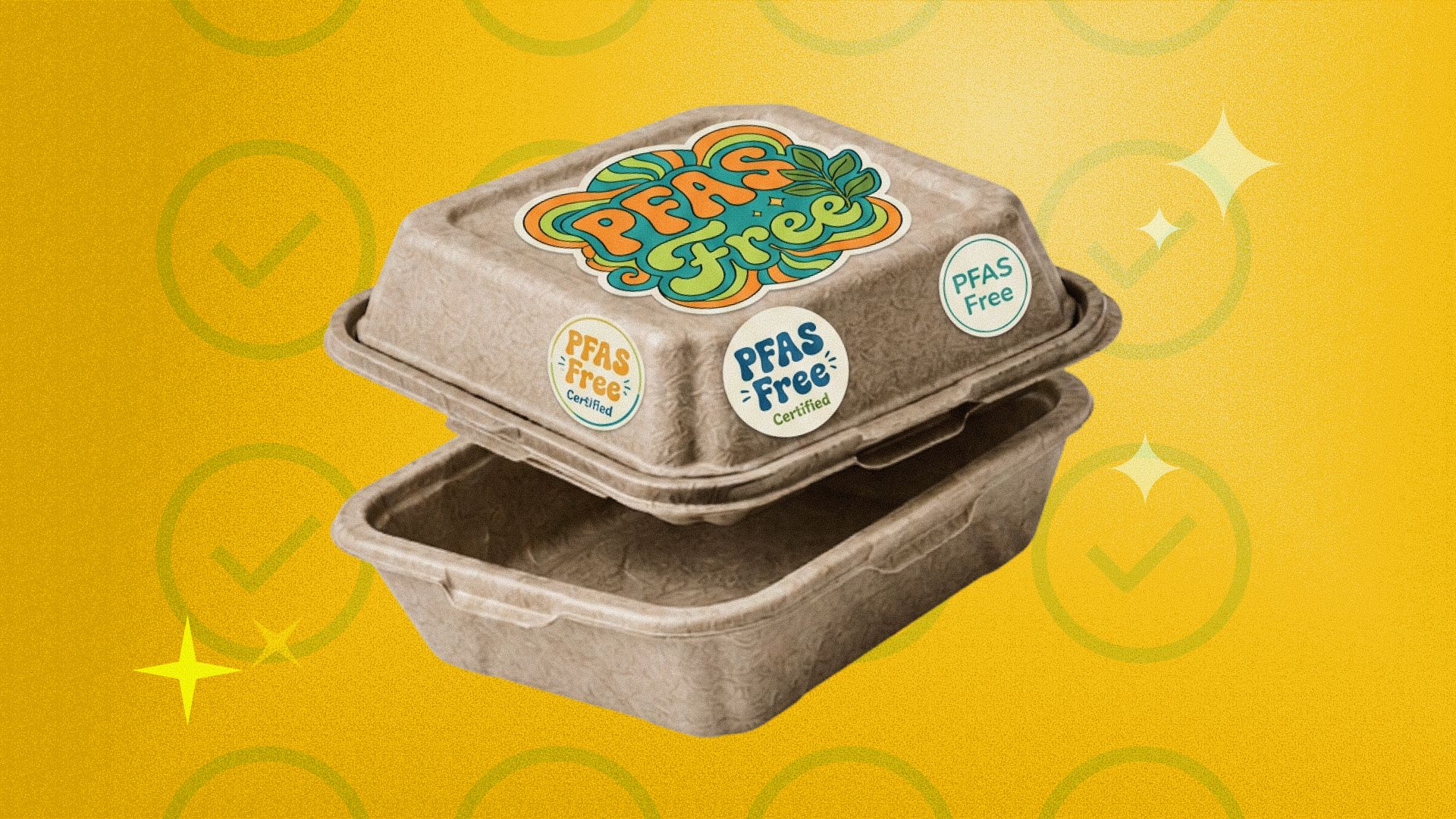
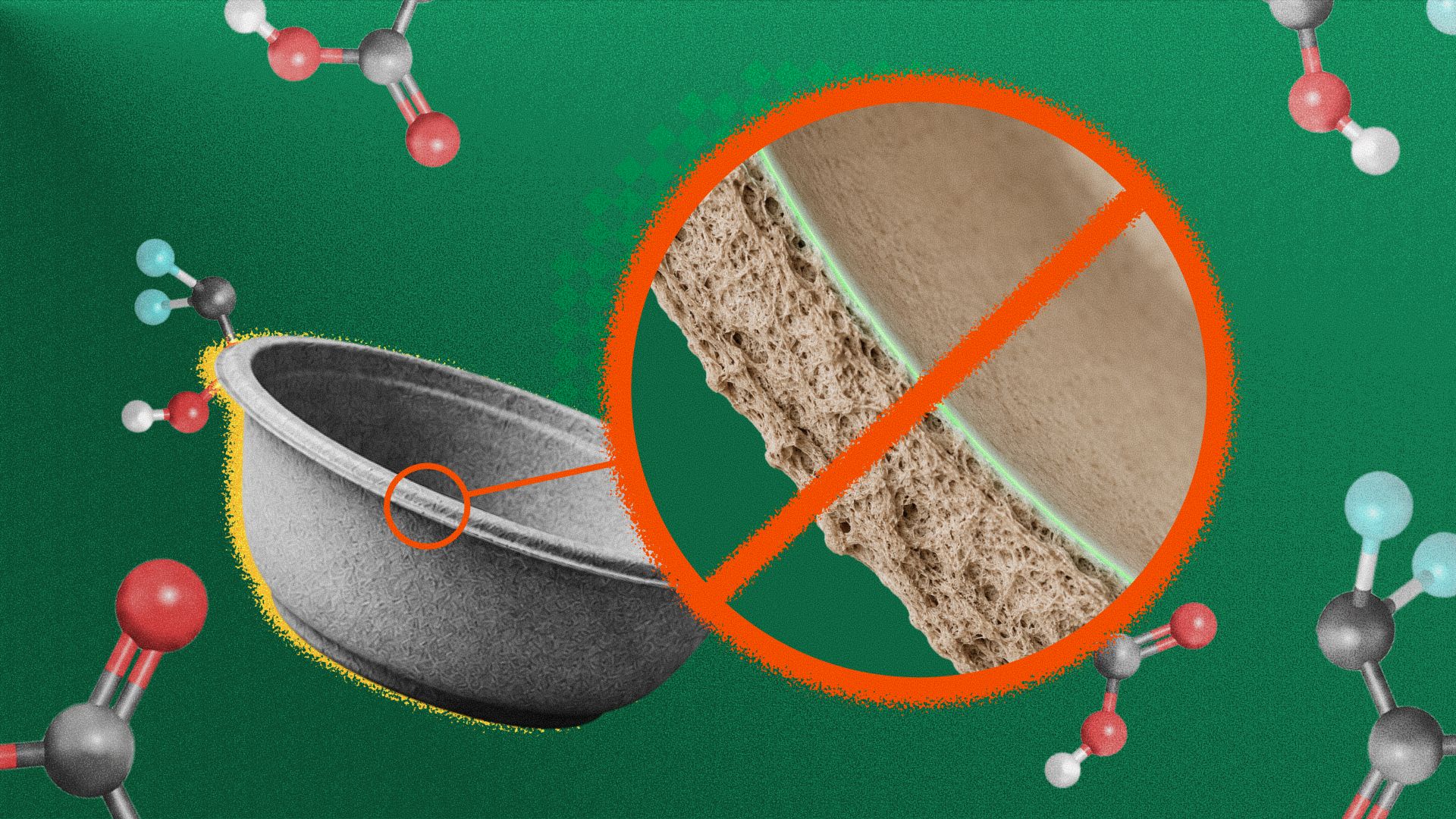
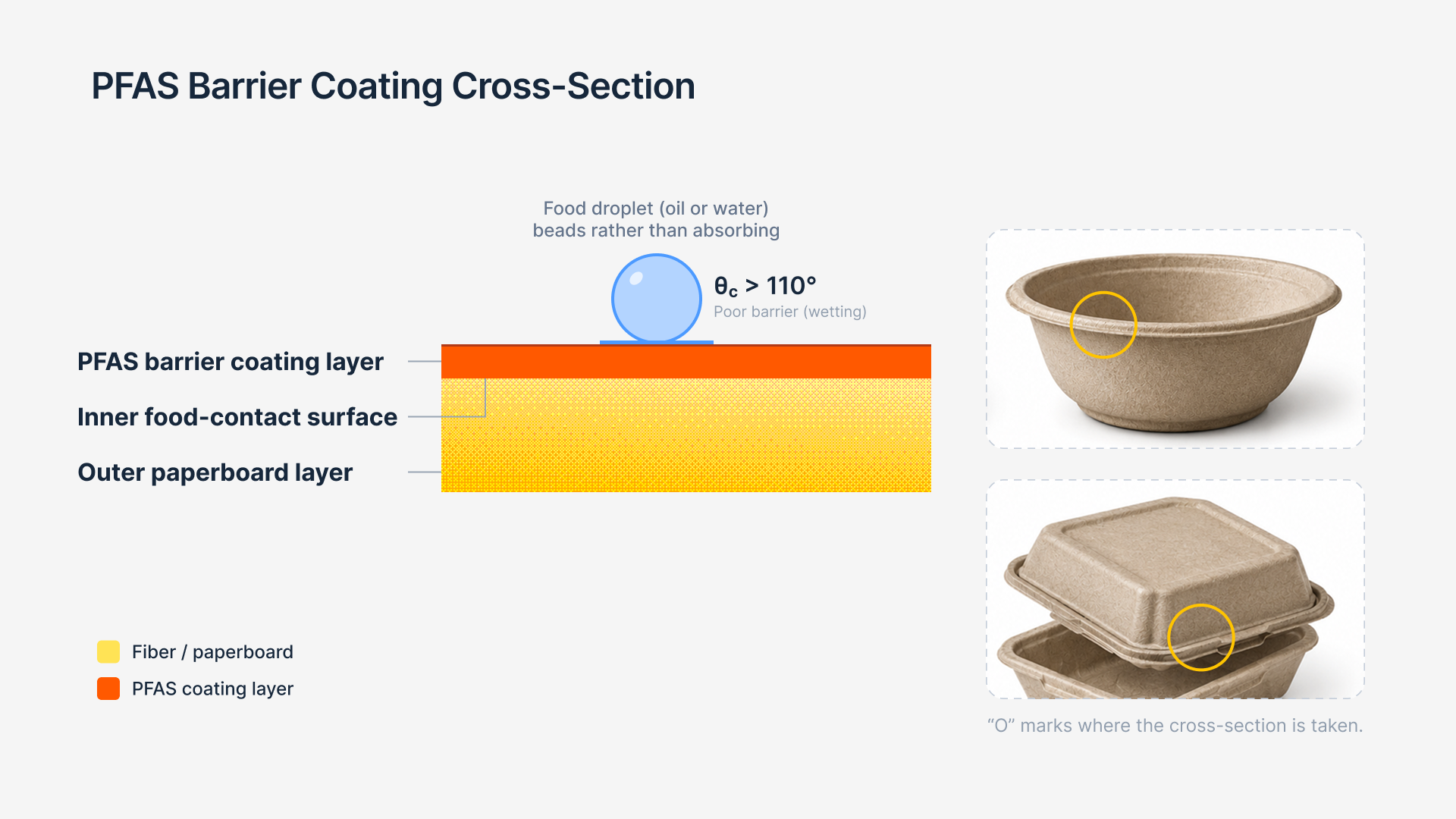
PFAS (per- and polyfluoroalkyl substances) are a family of more than 10,000 synthetic compounds, often called forever chemicals, valued for one property above all: they repel grease, oil, and water. That made them an obvious choice for fiber-based food packaging, where they were applied as a thin barrier coating, the layer that keeps a takeout box from going translucent under a burger, or a molded-fiber bowl from leaking under hot soup.
The same durability that made PFAS useful is exactly what made them a problem. These compounds do not break down readily in the environment or the body; they persist and accumulate. A coating that performs flawlessly for the life of a takeout container becomes a long-term contaminant the moment that container reaches a recycling stream, a compost facility, or a landfill. That contradiction, high performance paired with permanence, is what eventually put food packaging in the regulators' sights.
Why Are Regulators Banning PFAS in Food Packaging?
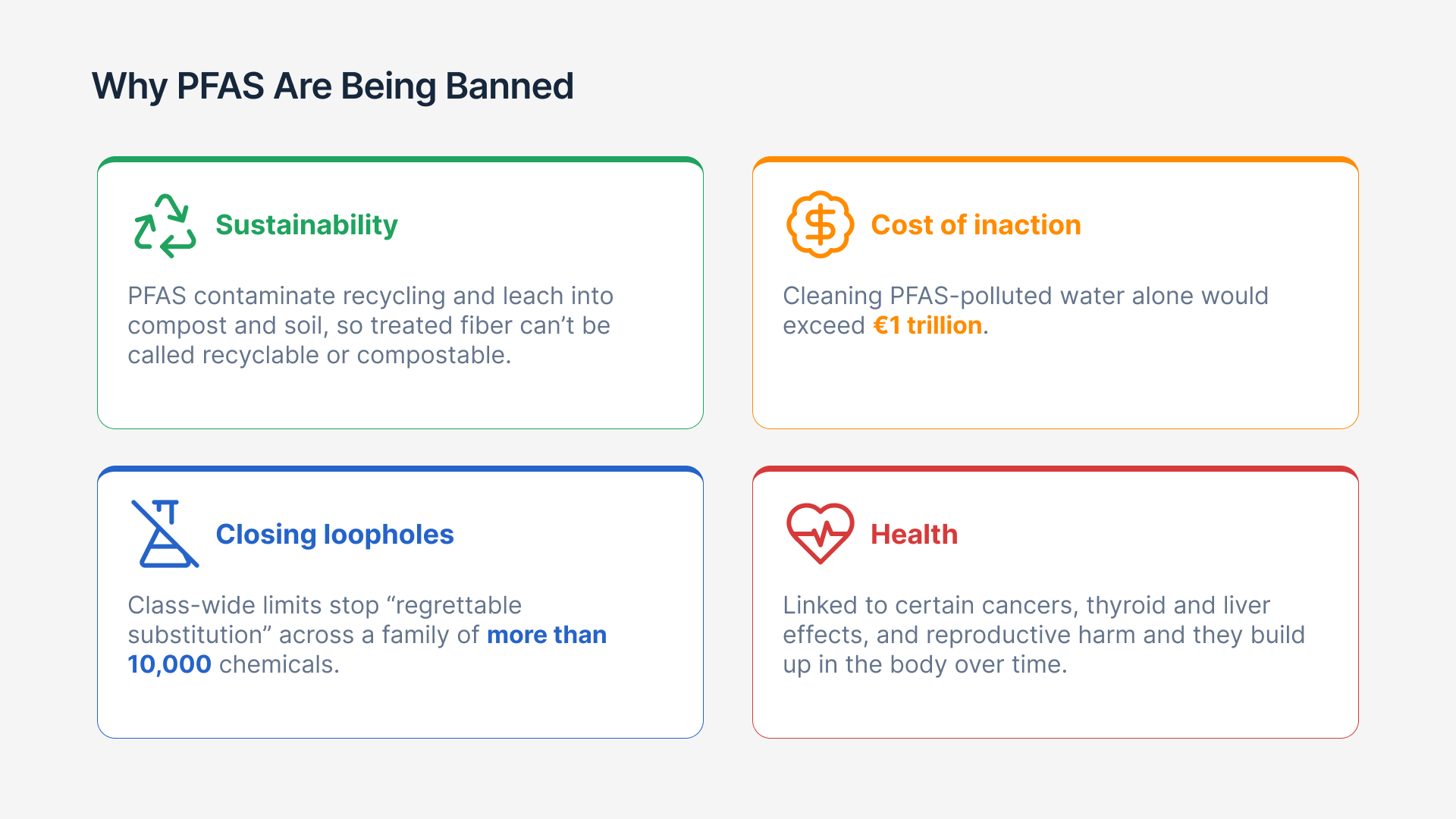
Four reinforcing reasons are driving the restrictions: environmental damage, the rising cost of inaction, the futility of banning compounds one at a time, and documented human health harm. Together, they explain why the rules are arriving across regions at once.
- Sustainability. PFAS contaminate recycling streams and leach into compost and soil, so PFAS-treated fiber cannot honestly be called recyclable or compostable. Going PFAS-free is a prerequisite for those claims, not an optional extra.
- Cost of inaction. A 2026 study commissioned for the European Commission estimated that if PFAS pollution continues at current levels without regulatory action, it will cost EU society approximately €440 billion by 2050, while treating the polluted water alone would exceed €1 trillion. Acting at the source is far cheaper.
- Closing loopholes. Because the PFAS family runs to more than 10,000 chemicals, several jurisdictions are moving to class-wide limits rather than banning compounds individually. The aim is to stop regrettable substitution, where a banned PFAS such as PFOA is simply swapped for an unregulated cousin such as GenX.
- Health. PFAS exposure has been linked to certain cancers, elevated cholesterol, thyroid and liver effects, and reproductive harm, and the chemicals build up in people over time. Food packaging was a notable exposure pathway.
The 2026 PFAS Packaging Bans Across Canada, the EU, and the US
Canada, the European Union, and the United States are the three markets that decide the rules for most brands selling in North America and Europe, and all three moved on PFAS within the same narrow window. If your packaging touches any of these markets, the strictest of the three effectively sets your specification, because aligning to it is the most efficient way to sell across all of them. Here is what each requires.
Canada: Federal Restriction In Force Since June 30, 2026
Canada moves first chronologically. Federal regulation SOR/2025-270 took effect on June 30, 2026, restricting legacy PFAS (PFOA, PFOS, and LC-PFCAs, along with their salts and precursors) in products including paper and packaging.
Scope: the ban covers both imports and recycled content unless the presence is genuinely incidental, and importers must keep records showing their compliance efforts.
What's next: this is Wave 1, with a broader class-wide ban aimed at food packaging expected around 2027 to close the loophole of swapping one PFAS compound for another. See the ECCC overview for full scope.
The European Union: PPWR Effective August 12, 2026
The EU goes furthest in both scope and documentation. The Packaging and Packaging Waste Regulation (PPWR, EU 2025/40) was adopted in December 2024 and entered into force in February 2025, with its PFAS limit values for food-contact packaging taking effect on August 12, 2026. From that date, intentionally added PFAS are banned in food-contact packaging across all 27 member states.
Thresholds: the limits are strict and tiered, set at 25 parts per billion for any individual PFAS, 250 parts per billion for the sum of targeted PFAS, and 50 parts per million for total fluorine including polymeric PFAS, with no exemptions for stock already produced.
Proof: the EU is the only one of the three regions that requires accredited-lab Certificates of Analysis (CoAs) as evidence of compliance, which raises the documentation bar for any brand selling into Europe. Denmark set the direction years ago, banning PFAS in food-contact paper and board back in 2020.
The United States: FDA Phase-Out Plus a Growing Patchwork of State Laws
The United States is the most fragmented of the three. At the federal level, the FDA completed a market phase-out of greaseproofing PFAS in US food packaging in 2024, and declared 35 related food contact notifications no longer effective in January 2025. A federal class-wide bill was introduced in 2026 but has not yet become law.
State laws: more than a dozen states now ban intentionally added PFAS in food packaging, with effective dates running from 2022 in New York through 2028 in New Jersey, and California and Washington in between.
Proof: requirements vary state to state, so compliance depends on which states a product reaches, and some mandate disclosure.
Who Is Liable for PFAS Under the New Packaging Rules
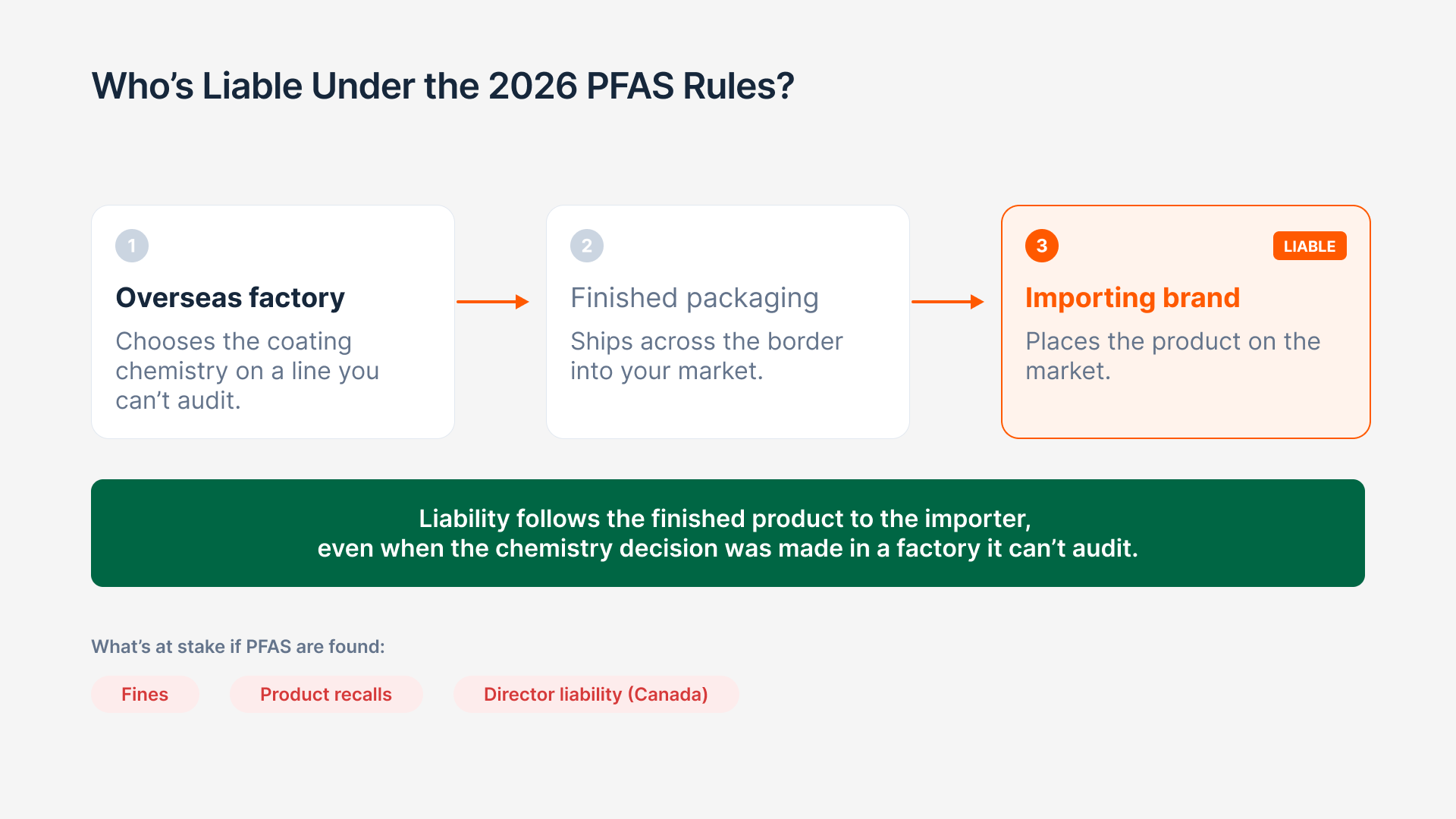
Legal responsibility now rests with the brand that places the product on the market, not the overseas manufacturer that produced it. Across all three regimes, the importer of record is the accountable party, which means a coating decision made on a factory line abroad becomes the importing brand's exposure at home.
In practice, the rules turn on whether PFAS are present, not on whether you hold paperwork. Genuinely PFAS-free packaging is legal to import into Canada and the US even without a certificate in hand, though the EU treats the absence of lab proof as non-compliant on its own (EC Regulation 1935/2004, Article 16). If the packaging does contain PFAS, the importing brand is liable even when it did not know. The exposure can include fines, product recalls, and in Canada, potential personal liability for company directors (Canadian Environmental Protection Act (CEPA), 1999, Section 280).
In short, the burden of knowing has shifted onto the buyer. That reframes PFAS from a supplier's technical detail into a question of corporate accountability that sits with your brand.
Why Imported Packaging Carries the Greatest PFAS Risk
Imported packaging concentrates the risk because liability follows the finished product to the importer, while the chemistry is decided in a factory the importer cannot see into. When you place imported packaging on the market, you inherit responsibility for a coating choice made on a line you do not control and probably cannot audit.
- Overseas does not mean compliant. "Made overseas" means unverified, and unverified is not a safe default. China, for example, has no food-packaging PFAS ban equivalent to these rules; its food-contact standards approve permitted materials but do not specifically prohibit PFAS.
- Direct sourcing carries the risk blind. A brand buying directly from a single factory rarely has the standing to audit that factory's coatings or to obtain accredited third-party lab proof.
- The problem surfaces late. It tends to appear at a customs check, a lab test, or a retailer audit, after the inventory is made and shipped.
This is the gap that turns a chemistry question into a business risk. The brand most exposed to the fine, the recall, and the lost retail listing is the one with the least visibility into how its packaging was made.
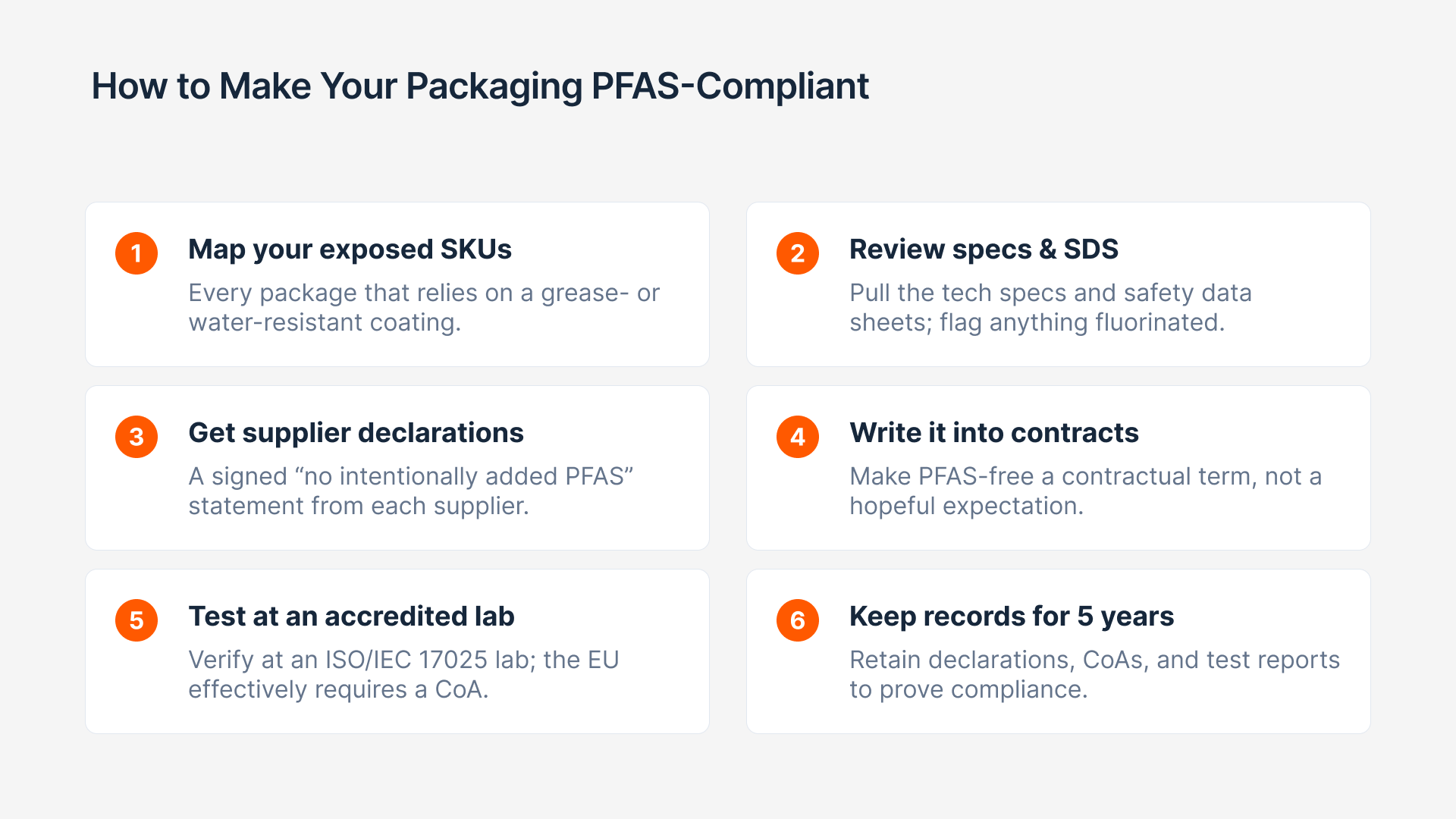
How to Make Your Packaging PFAS-Compliant
The path from unverified to PFAS-compliant is well established, and it works whether you manage one supplier or many. Close the verification gap before a deadline or an audit closes it for you.
- Map your exposed SKUs. Identify every package that relies on a grease- or water-resistant coating, including takeout containers, molded-fiber trays, wraps, lined cartons, and coated cups.
- Review specs and safety data sheets (SDS). Pull the technical specs and SDS for those materials, and flag anything fluorinated or unverified.
- Get written supplier declarations. Require a signed statement of no intentionally added PFAS from each supplier, and verbal assurances are not enough.
- Write it into your contracts. Make PFAS-free a contractual term, not a hopeful expectation.
- Test at an accredited lab. Verify with an ISO/IEC 17025-accredited laboratory. The EU effectively requires a CoA, and lab proof is the strongest evidence everywhere else.
- Keep records for 5 years. Retain declarations, CoAs, and test reports for at least five years, the retention period most jurisdictions require, so you can demonstrate compliance on demand.
How PakFactory De-Risks PFAS-Free Packaging Sourcing
The core problem, chemistry decided in a factory you cannot audit, is exactly what an orchestrated supply chain is built to solve. PakFactory governs the overseas supply chain through a vetted global manufacturing network and network-level quality assurance, so an importing brand does not inherit unverified risk. That is the difference between sourcing direct to factory, where the compliance burden transfers entirely to the buyer, and working with an end-to-end orchestrator that carries verification and documentation with the order.
De-risking comes down to two things PakFactory delivers together: PFAS-free materials, and the documentation that proves they comply.
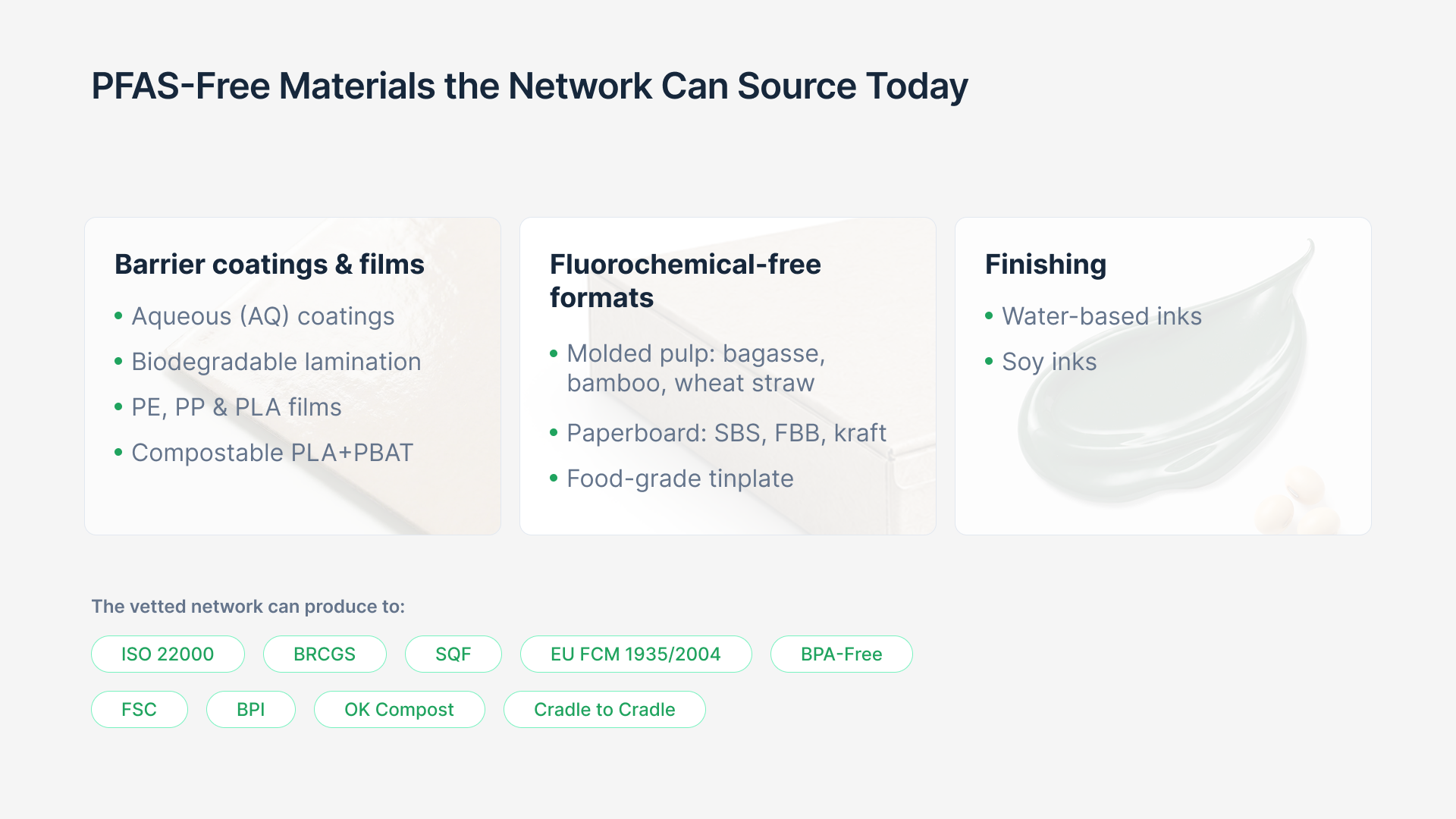
PFAS-free materials the network can produce today.
- Barrier coatings and films. Aqueous (AQ) coatings, biodegradable lamination, PE, PP, and PLA films, and compostable PLA+PBAT.
- Inherently fluorochemical-free formats. Molded pulp (bagasse, bamboo, or wheat straw), paperboard (SBS, FBB, and kraft), and food-grade tinplate.
- Finishing. Water-based and soy inks.
And the documentation to prove it.
PakFactory’s vetted network can produce packaging meeting recognized standards, including ISO 22000, BRCGS, SQF, EU Food Contact Materials Regulation 1935/2004, BPA-Free, FSC, BPI, OK Compost, and Cradle to Cradle, and can supply the supplier declarations and accredited-lab CoAs the new rules call for. PakFactory holds FSC chain-of-custody and SGS certification directly, so the proof travels with the order rather than being chased after the fact.
Ready to check your exposure? Book a PakFactory PFAS-free sourcing review, and our team will map your at-risk SKUs, match each to a compliant material, and line up the documentation you need for Canada, the EU, and the US.
Sources
- Canada Gazette, Part II, SOR/2025-270: full text; ECCC overview.
- EU PPWR (EU 2025/40): Food Safety Magazine; Denmark 2020 ban, SGS.
- European Commission: New study confirms huge and growing costs of PFAS pollution
- European Commission: The Cost of PFAS Pollution for Our Society (final report)
- US: FDA market phase-out; MultiState; Morgan Lewis state tracker.
- Overseas sourcing context: SGS on China food-contact standards (GB 4806.10-2025).
- PFAS chemical count: EPA PFAS lists.
Frequently asked questions
Written by
5+ years in content strategy — building packaging case studies, guides, and blogs.