Key takeaways
By 2026, packaging EPR is an operating cost across North America, not a future risk. About nine Canadian programs and seven U.S. state laws now require producers to register, report, and pay, with fees set by a base rate per material plus an eco-modulation adjustment by design. Producers are modeling packaging-spend increases in the range of 15–40% as a planning scenario. The hardest part isn't the materials; it's the lack of harmonization between programs and the SKU-level data each one demands. The durable response is to design for recyclability and give auditable packaging data a single owner.
A Reference Guide for Canada and the United States
2026 edition. Current as of July 2026.
An industry reference on the rules, actors, fees, deadlines, and outlook for packaging EPR across North America.
1. What Is EPR?
Extended Producer Responsibility (EPR) is a policy model that shifts the cost and management of packaging waste from municipalities and taxpayers to the producers that place packaging on the market. The aim is to make the companies that design and sell packaging bear its end-of-life cost, and to push packaging toward designs that are easier to recycle.
First defined in Sweden in 1990 and first enacted for packaging in Germany in 1991, EPR now operates across the EU, the UK, and much of Asia and Latin America. This guide focuses on Canada and the United States.
By 2026, EPR packaging programs had moved from a prospective concern to an operating reality across North America. Canada runs roughly nine provincial and territorial programs, the most established of which have operated for over a decade. In the United States, seven states have enacted packaging EPR laws, and on or around May 31, 2026, several required producers to file their first formal supply reports. This guide covers EPR mechanics, fee structures, the principal actors, jurisdictional status, the 2026 reporting cycle, the main risks, a multi-year calendar, and the outlook.
Dates, thresholds, and figures are drawn from regulator publications, producer responsibility organizations, and legal and industry analyses cited in Sources. EPR rules change quickly, so verify any specific obligation against the relevant regulator before acting.
2. How Does EPR Work?
2.1 The core mechanism of EPR
A producer that sells covered packaging into a regulated jurisdiction must register with the program or its producer responsibility organization, report the quantity and type of packaging supplied in the prior year, and pay fees calculated from that report. In most programs the producer also assumes operational responsibility for the recycling system, not only its funding. The fees fund collection, sorting, and recycling, and in several programs the performance targets the jurisdiction sets for recyclability and recycling rates.
2.2 Which businesses must comply with EPR?
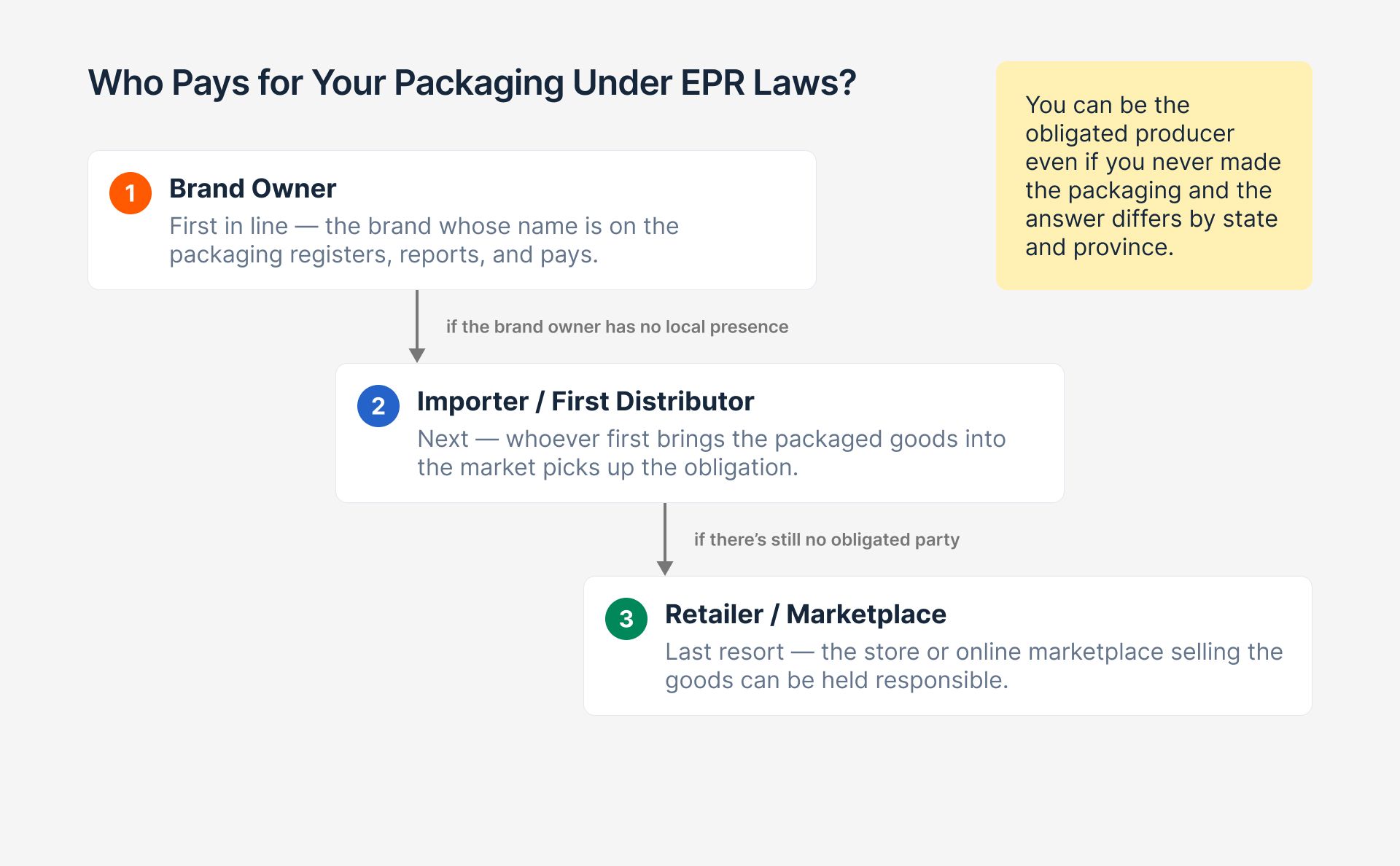
Programs assign the obligation using a defined hierarchy rather than a single rule. The obligated producer is typically the brand owner whose name appears on the packaging. Where the brand owner has no presence in the jurisdiction, the obligation falls to the importer or first distributor, and in some cases to the retailer or marketplace. A company can be the obligated producer even if it did not manufacture the packaging itself, so producers operating across multiple jurisdictions should confirm where they sit in each hierarchy.

2.3 Covered materials
Most programs cover primary, secondary, and e-commerce packaging, plus printed paper in Canada and several US states. Typical material categories include paper, corrugated and cartonboard, glass, metal, rigid plastic, and flexible or multi-layer plastic. Some programs also cover single-use food serviceware. Beverage containers are treated differently where separate deposit-return systems exist, and exclusions vary, so the covered-materials list must be checked program by program.
Each program publishes its own covered-materials list, so confirm it for every jurisdiction you sell into. For example, Circular Action Alliance (Oregon), Circular Materials – designated materials (Canada), and Recycle BC material list (British Columbia).
2.4 Small-producer and de minimis exemptions
Programs commonly exempt the smallest producers, setting a low-revenue or low-tonnage threshold below which a producer is not obligated. California, for example, lets producers with under one million dollars in annual in-state gross sales apply for an exemption (CalRecycle, SB 54). Exemptions are rarely automatic, though: a producer usually must register and claim the exemption, and a regulator can deny it if granting it would undermine a program target.
3. How Are EPR Fees Calculated?
3.1 Two layers: base fee and eco-modulation
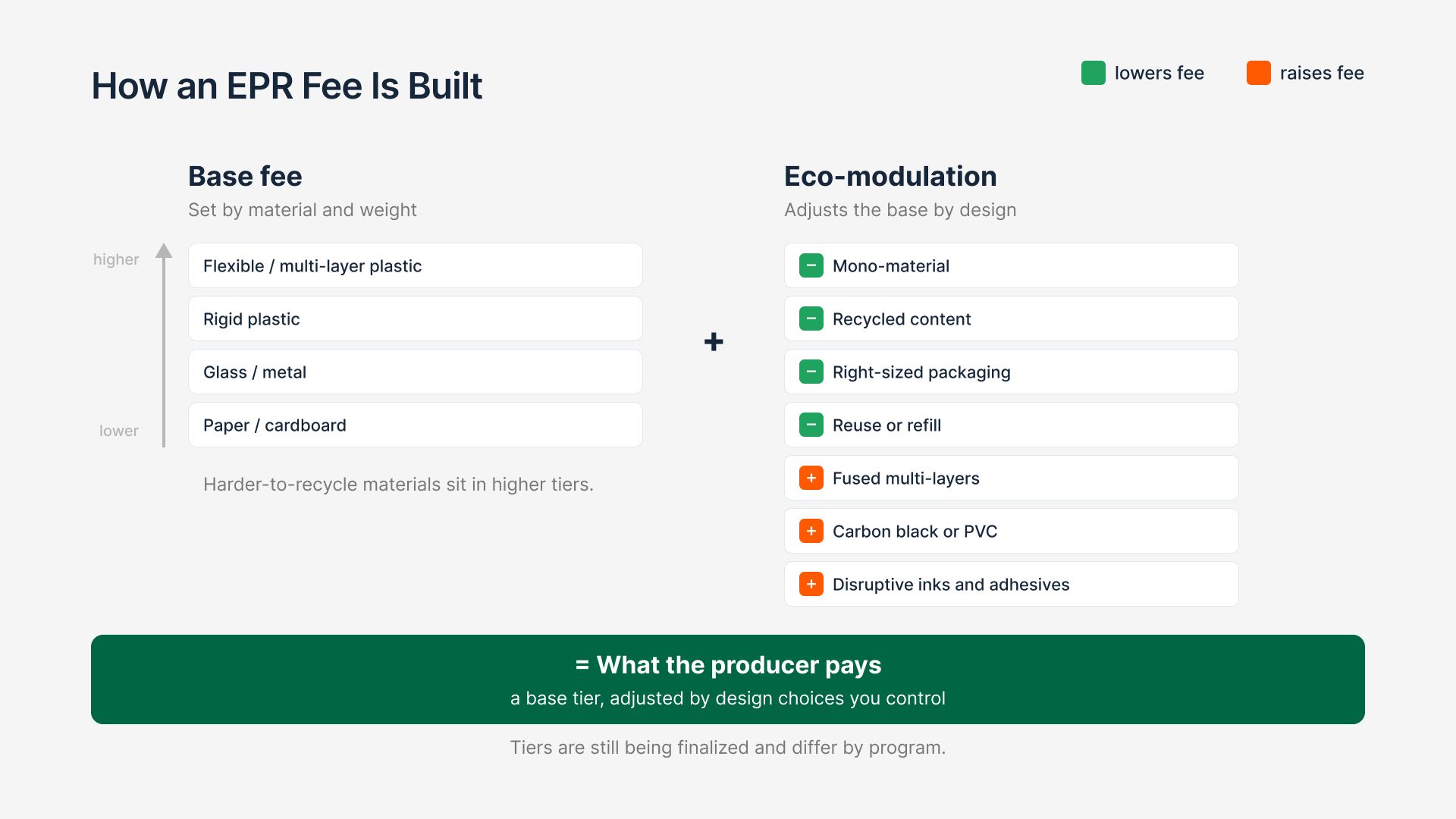
The first layer is a base fee set by material category and weight. Each category carries a published rate, and a producer multiplies the weight it supplies in each category by that rate. The harder a material is to collect and recycle, the higher the rate, so flexible and multi-layer plastics sit near the top of the scale while widely recycled materials such as corrugated and paper sit near the bottom. Programs publish these rates in cents per pound in the US and in cents per kilogram or dollars per tonne in Canada, and reset them each program year.
The figures below are drawn from Circular Action Alliance's 2026 Oregon producer fee schedule. Oregon's full schedule spans roughly 60 material categories; a few are shown here to illustrate the spread.
Worked example: a producer that supplies 10,000 pounds of clear PET bottles and 2,000 pounds of flexible HDPE/LDPE film into Oregon would owe a base fee of roughly (10,000 × $0.25) plus (2,000 × $0.43), or about $3,360, before any eco-modulation adjustment.
3.2 What is eco-modulation?
Eco-modulation is the second layer: an adjustment that moves the base fee up or down based on how a specific package is designed, on a bonus-and-malus logic. Design choices that are easier for the system to recover earn lower fees or credits, including mono-material construction, post-consumer recycled content, right-sized packaging, recycling-friendly labeling, and reusable or refillable formats. Design choices that burden the system carry a surcharge, including fused multi-layer structures, problematic additives such as carbon black or PVC, and inks or adhesives that disrupt sorting and reprocessing.
3.3 Eco-modulation in practice: Oregon's bonuses
Oregon, the first US program to charge fees, layers defined bonuses on top of its base fees. Producers that perform and disclose a life-cycle assessment (LCA) on eligible items can receive a bonus set at a share of base fees, capped per item. A separate bonus rewards comparative LCAs that demonstrate a reduction in environmental impact, and a further bonus is being introduced for producers that move products from single-use into reusable or refillable formats. The direction of travel is clear: programs are tying fees to demonstrable design improvement, not just material weight.
Where to find and calculate fees: Oregon producer fee schedule (CAA) · CAA producer resource center · Recycle BC fee schedule · Circular Materials annual producer fees
3.4 Cost outlook
Fee schedules are still settling, so treat any percentage as illustrative, not fixed. As a planning range, some advisors suggest modeling a roughly 15–40% increase in packaging spend as base rates and eco-modulation criteria are finalized, a scenario to budget against, not a published rate.
4. The Actors
- Producers are the obligated party. They register, report, and pay.
- Producer Responsibility Organizations (PROs) are the non-profit bodies that collect fees and run the program on producers' behalf. In Canada, programs are run by provincial PROs such as Recycle BC and Circular Materials; in the United States, a single PRO, the Circular Action Alliance (CAA), runs six of the seven state programs, with Maine's stewardship organization still being selected.
- Regulators write the rules, approve program plans, and enforce compliance: CalRecycle in California, the Department of Environmental Quality in Oregon, and the Resource Productivity and Recovery Authority in Ontario.
- Municipalities, recyclers, and consumers sit downstream. They collect, sort, and process the material the producer fees are designed to fund.
5. Canada: The Established Model
Packaging EPR in Canada is a provincial and territorial matter, not a single federal law. Roughly nine jurisdictions run programs, each with its own regulation, PRO, and timeline, but they share a common annual reporting deadline of May 31 for the prior calendar year's supply data. Separately, the federal Plastics Registry requires producers to report plastics placed on the Canadian market to the federal government, an obligation distinct from the provincial EPR programs.
5.1 Notes by jurisdiction
The table above carries the status, PRO, oversight body, and reporting date for each program. The notes below add the context that matters most to producers.
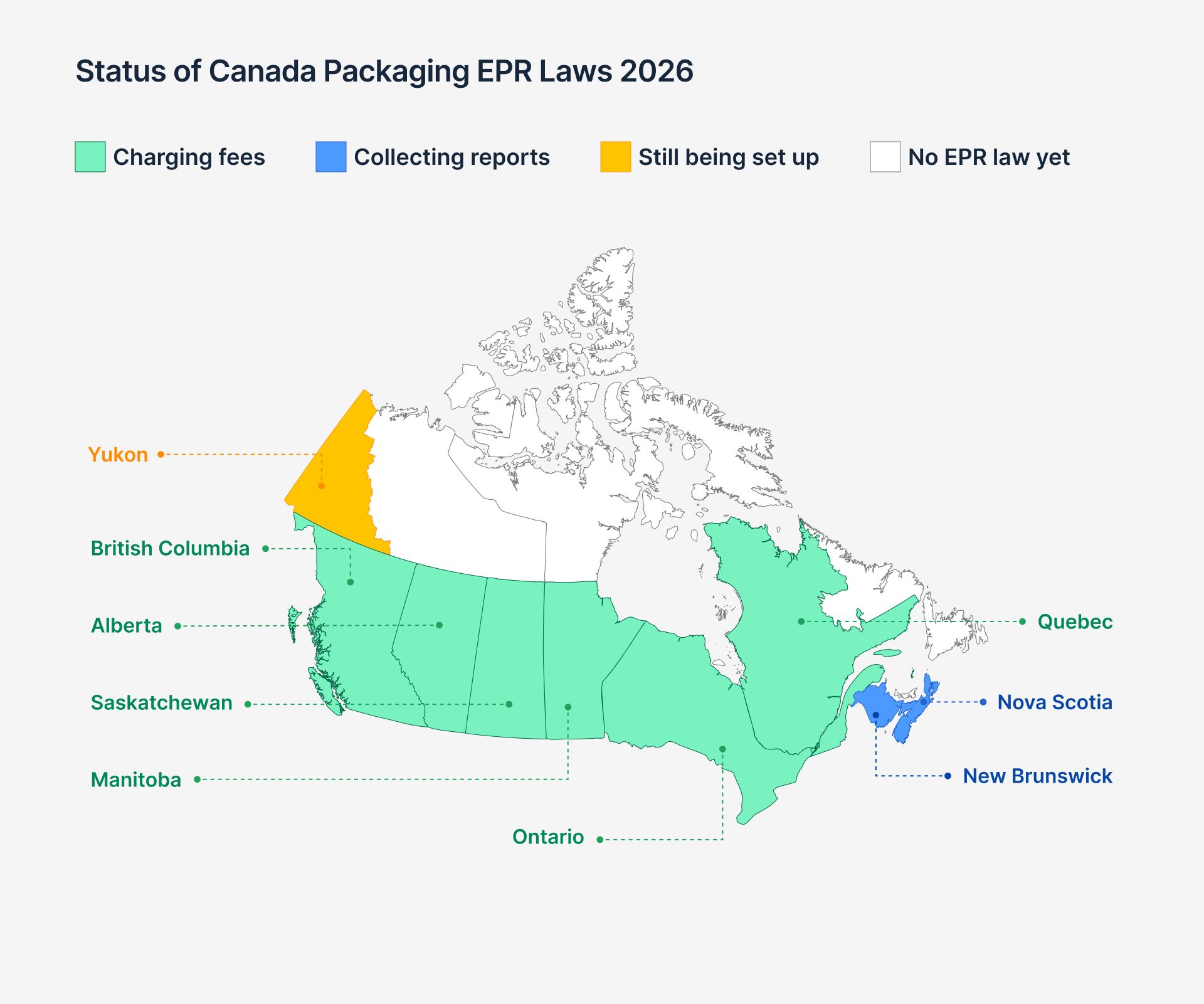
- British Columbia. The reference model and longest-running program for other provinces follow.
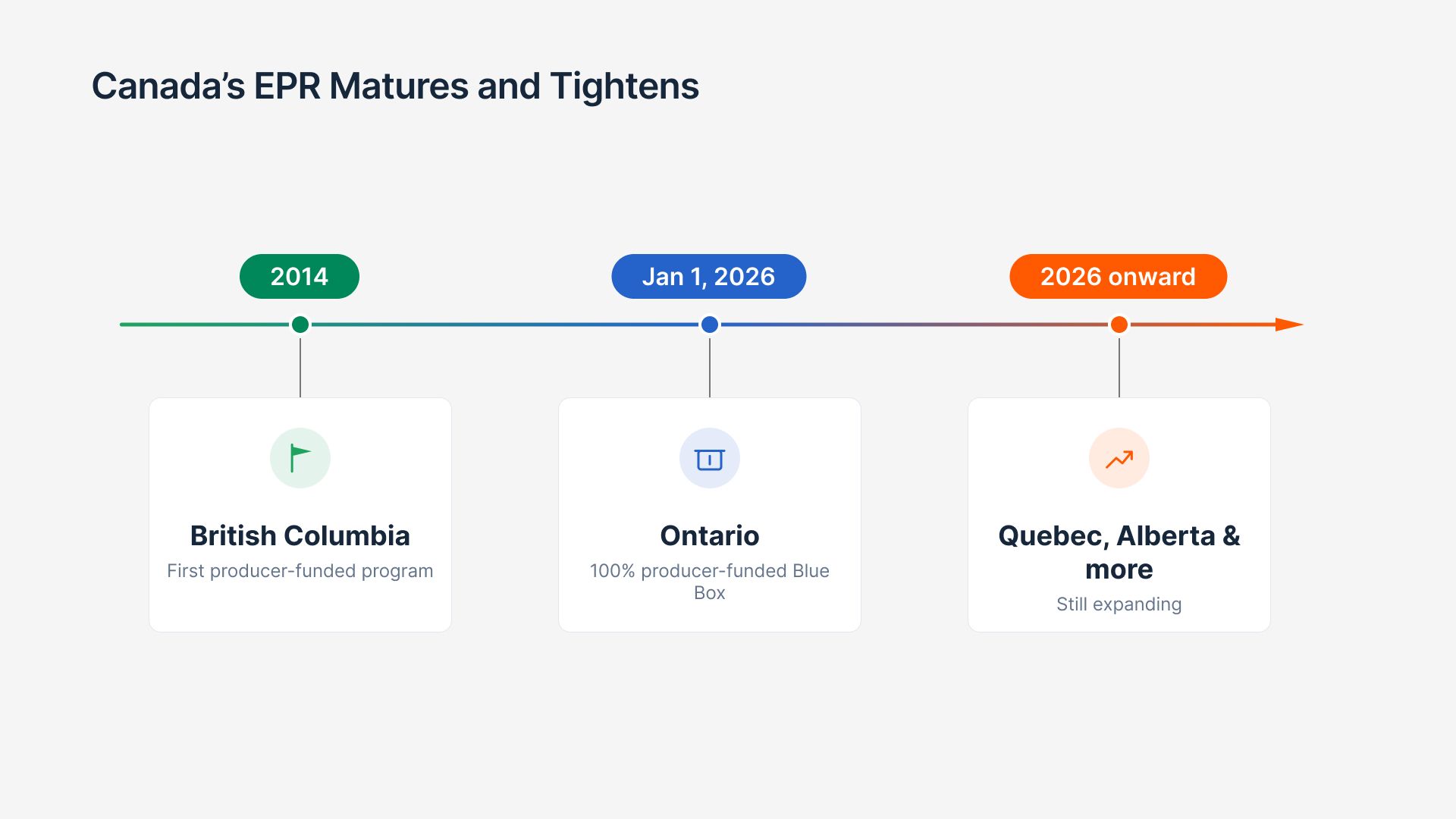
- Ontario. The 2026 milestone. It completed a three-year handover to 100% producer funding on January 1, 2026, with the province's first standardized material list.
- Québec. It uniquely extends beyond residential packaging to the industrial, commercial, and institutional sector, with that reporting beginning in 2026.
- Alberta. A phased rollout. Phase 1 launched April 1, 2025, and Phase 2 on October 1, 2026 extends coverage to communities without prior service.
- Saskatchewan and Manitoba. Both are mid-transition from older shared-funding models to full producer responsibility, with Saskatchewan scheduled to complete by about 2028.
- Nova Scotia and New Brunswick. The Atlantic programs. Nova Scotia launched in 2025, and New Brunswick's new regulation took effect January 1, 2026, formalizing the producer hierarchy and expanding designated materials.
- Yukon. The most recent program, which began in late 2025.
- Not yet covered. Prince Edward Island, Newfoundland and Labrador, the Northwest Territories, and Nunavut have no packaging EPR program, the gaps in an otherwise near-national framework.
6. The United States: The New Frontier
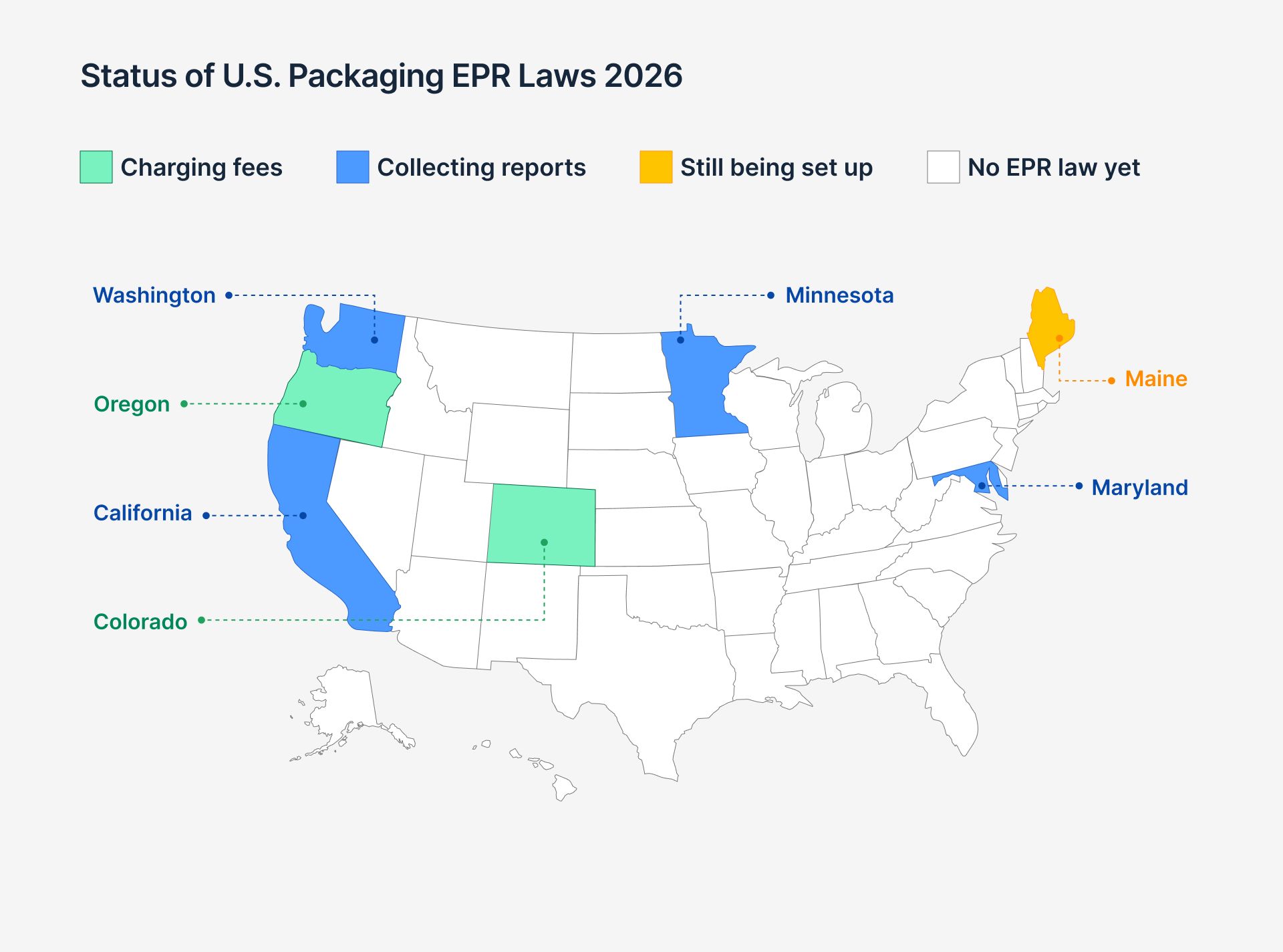
There is no federal packaging EPR law, so EPR regulations are defined state by state, and the definitions, material categories, and reporting formats differ across programs. In 2026, the earliest programs turned into real reporting and real fees, while later programs collected their first data.
6.1 Oregon EPR
First to launch (July 2025) and first into active enforcement, publicly listing non-compliant producers and referring cases to the state regulator. A trade-group challenge by the National Association of Wholesaler-Distributors won a partial preliminary injunction in February 2026, with trial firmly set for July 13, 2026.
6.2 Colorado EPR
Fees began January 2026. The program faces a separate trade-group challenge: the Independent Lubricant Manufacturers Association filed suit in Colorado state court in March 2026, contesting the delegation of authority to the PRO.
6.3 California EPR (SB 54)
The most far-reaching program and the cautionary tale. SB 54's rules were finalized only weeks before the May 31 deadline; the program covers more than 5,700 producers, and its 2032 targets include a 25 percent cut in single-use plastic and a 65 percent recycling rate for single-use plastic packaging.
6.4 Minnesota, Maryland, and Washington EPR
Each collected a simplified first report in 2026, with fee obligations expected around 2028. Maryland's producer registration was due July 1, 2026.
6.5 Maine EPR
The first state to pass EPR (2021), but built on a municipal-reimbursement model rather than the PRO-fee model used elsewhere, and still being set up as its stewardship organization is selected.
6.6 US EPR Penalties and enforcement
- California. Administrative civil penalties up to $50,000 per day per violation, reduced to $25,000 per day for qualifying small producers.
- Oregon. Civil penalties of up to $25,000 per violation, with DEQ's penalty schedule setting daily base amounts by violation class and magnitude (roughly $1,000 to $12,000 per day).
- Colorado. $5,000 for the first day plus $1,500 for each additional day until cured.
- Market access. Several programs condition the right to sell covered packaging on participation in an approved plan, so failing to join the PRO can mean a prohibition on selling packaged goods in the state.
6.7 The pipeline: states considering EPR
The seven enacted states are not the end of the trend. As of July 2026, the pipeline falls into three groups:
- New 2026 bills: New Hampshire and Wisconsin introduced packaging EPR bills, and New Jersey reintroduced prior-session bills.
- Carried over from 2025: Illinois, Massachusetts, New York, and Tennessee are still weighing bills from last year, and Vermont is considering a statewide needs assessment.
- Precursor steps: Rhode Island and Hawaii have enacted needs-assessment laws, often the first step toward a future program.
National producers should track this pipeline, because today's proposals become tomorrow's obligations.
7. The 2026 Reporting Cycle
What came due: On or around May 31, 2026, six US states' packaging EPR reports fell due in the same window, and Canada's provincial programs share that May 31 date, concentrating the work in late spring.
Two report formats: California, Colorado, and Oregon required detailed reports with SKU- and component-level data; Minnesota, Maryland, and Washington accepted simplified reports using aggregated material weights.
Why it strained teams: a national producer had to assemble auditable, product-level data for several programs at once, each with different definitions and formats.
The California wrinkle: its permanent SB 54 rules were finalized only on May 1, 2026, leaving producers a matter of weeks to pull 2025 supply and source-reduction data before the deadline.
8. Key Challenges and Risk Areas
- No harmonization. Every program sets its own definitions, categories, and formats, so a national producer cannot file once. Advisors widely identified this as the hardest part of 2026.
- Eco-modulation uncertainty. Fee schedules and modulation criteria are still being finalized, so producers make design and sourcing decisions without full visibility into eventual cost, while modeling an illustrative 15–40% increase in packaging spend.
- Reporting burden. Regulators want auditable, SKU-level data on material, weight, and recyclability. Incomplete or inaccurate reporting is a common trigger for enforcement and fines.
- Supplier data dependency. Accurate material weights and recyclability often sit with upstream suppliers; missing or inconsistent supplier data is a frequent failure point.
- Data ownership. The producers that struggled most were usually compliant on materials but could not assemble a clean report, because the data lived in separate systems with no single owner.
- Active enforcement and litigation. Oregon is publicly listing non-compliant producers, and trade-group lawsuits are proceeding against both programs: the Oregon case (NAW) is set for trial on July 13, 2026, and a separate Colorado challenge (ILMA) was filed in March 2026.
9. Key Dates Calendar
10. What EPR Means for Brands and Operations
- Reporting sets a baseline. A producer's first report becomes the floor future reporting has to keep clearing.
- Material and format choices carry a recurring price. Because eco-modulation prices each design decision, packaging belongs in a Total Cost of Ownership analysis that accounts for the recurring fee, not only the unit price.
- Data needs an owner. Auditable, current data on material, weight, recyclability, recycled content, and supply by jurisdiction must be maintained continuously and owned across the portfolio.
10.1 What best practices are leading teams doing?
- Centralize packaging data. Hold composition, component weights, recyclability by market, and supporting evidence such as certificates and test results in one standardized, owned system rather than scattered spreadsheets and PDFs.
- Assign cross-functional ownership. Give packaging, procurement, sustainability, regulatory, legal, and finance clear roles, and determine who the legal producer is in each state.
- Build EPR into procurement. Make full bill-of-materials visibility, recyclability by region, and supplier reporting-readiness selection criteria alongside cost and aesthetics.
- Design for recyclability. Simplify structures, move to mono-material formats where feasible, and reduce decoration that interferes with sortability, treating eco-modulation as a design signal rather than only a compliance cost.
- Budget for rising fees. Plan for eco-modulated fees that climb as programs mature, and model both low- and high-cost scenarios inside a total-cost-of-ownership view.
- Plan portfolio-wide. Manage EPR across the whole portfolio and across jurisdictions on a continuous basis, not SKU by SKU at each deadline.
11. Outlook: 2027 and Beyond
Three trends are likely to define the next phase:
- Scope expands. Additional states enact programs, and Canadian programs still transitioning reach full producer responsibility.
- Fees rise and sharpen. Base rates settle and eco-modulation criteria become more granular, widening the cost gap between recyclable and hard-to-recycle packaging.
- Expectations tighten. Programs move from collecting baseline data toward enforcing source-reduction and recycling-rate targets, with California's 2032 goals an early example of where mature programs are heading.
The practical direction for producers is consistent across both countries: design for recyclability, build reliable packaging data, and treat EPR exposure as a standing cost to be managed rather than a deadline to be met.
Sources
Regulators and producer responsibility organizations
- CalRecycle, SB 54 packaging EPR. https://calrecycle.ca.gov/packaging/packaging-epr/
- Oregon Department of Environmental Quality, Recycling Modernization Act. https://www.oregon.gov/deq/recycling/pages/modernizing-oregons-recycling-system.aspx
- Resource Productivity and Recovery Authority (RPRA), Ontario completes transition to producer-run Blue Box. https://rpra.ca/2026/01/ontario-completes-transition-to-producer-run-blue-box-program/
- Circular Action Alliance, producer reporting resources. https://circularactionalliance.org/producer-resource-center
- Circular Materials, Ontario enhanced Blue Box program. https://www.circularmaterials.ca/news/ontario-welcomes-enhanced-blue-box-program/
- Government of Canada, Federal Plastics Registry. https://www.canada.ca/en/environment-climate-change/services/managing-reducing-waste/reduce-plastic-waste/federal-plastics-registry.html
Legal and industry analysis
- Holland & Knight, California final EPR regulations now in effect. https://www.hklaw.com/en/insights/publications/2026/05/californias-final-epr-regulations-now-in-effect
- Resource Recycling, CalRecycle approves SB 54 regulations. https://resource-recycling.com/plastics/2026/05/02/calrecycle-approves-sb-54-regulations/
- Faegre Drinker, EPR: six state reports due May 31. https://www.faegredrinker.com/en/insights/publications/2026/5/extended-producer-responsibility-six-state-reports-due-may-31
- Faegre Drinker, trade-group lawsuits challenge EPR laws in Oregon and Colorado. https://www.faegredrinker.com/en/insights/publications/2026/4/trade-group-lawsuits-challenge-extended-producer-responsibility-epr-laws-in-oregon-and-colorado
- Mayer Brown, EPR packaging laws moving from concept to compliance. https://www.mayerbrown.com/en/insights/publications/2026/02/epr-packaging-laws-moving-from-concept-to-compliance
- Printing United Alliance, six states face packaging EPR reporting deadline on May 31. https://www.printing.org/content/2026/05/07/six-states-face-packaging-epr-reporting-deadline-on-may-31
- Reverse Logistics Group, EPR packaging laws in Canada: where are we now. https://rev-log.com/epr-packaging-laws-in-canada-where-are-we-now/
- Packaging School, extended producer responsibility for packaging in Canada. https://packagingschool.com/lessons/extended-producer-responsibility-for-packaging-in-canada
- Packaging School, unpacking Oregon's eco-modulation bonuses. https://packagingschool.com/lessons/unpacking-oregons-ecomodulation-bonuses
- Compliance and Risks, EPR for packaging in the United States: a 2026 update. https://www.complianceandrisks.com/blog/extended-producer-responsibility-for-packaging-in-the-united-states-a-2025-update/
- H2 Compliance, EPR 2026 outlook for North America. https://h2compliance.com/extended-producer-responsibility-epr-2025-highlights-and-what-to-expect-in-2026-for-north-america/
Fee schedules
- Circular Action Alliance, Oregon 2026 producer fee schedule. https://circularactionalliance.org/s/OR-2026-Fee-Schedule-Public.pdf
- Recycle BC, fee schedule, British Columbia. https://recyclebc.ca/producers/reporting-fees/fee-schedule/
- Circular Materials, annual producer fees, Ontario and other provinces. https://www.circularmaterials.ca/annual-producer-fees/
This reference is provided for general information and is not legal advice. Verify specific obligations with the relevant regulator or PRO.
Frequently asked questions
Written by
5+ years in content strategy — building packaging case studies, guides, and blogs.