Key takeaways
Specify the bag to the contents, not to a general verdict: paper wins on feel, print, and perceived quality, plastic wins on wet strength and unit cost, and on environmental impact the number of reuses decides more than the material does.
- 01Paper raises perceived product quality; plastic reads utilitarian, per Sustainability, 2026.
- 02Untreated paper loses tensile strength when wet, which is why greaseproof and wet-strength grades exist.
- 03Specify for the wettest thing the bag will ever carry, not the average thing.
- 04A paper bag needs about 3 reuses to match single-use plastic, per the UK Environment Agency.
- 05Uncoated paper bags are widely recyclable; coated and laminated grades generally are not.
Last updated October 2026.
Most comparisons of the two materials are argued environmentally, but it is not the question that decides a purchase order. Which material survives the contents? And which one carries the brand once it leaves the counter?
This guide is written for the brand, operations, and procurement leads who have to answer both. It covers how paper and plastic compare, which bag to specify by application, what to ask a supplier, and where the environmental read actually lands. The commercial stake is not small: paper packaging measurably raises perceived product quality while plastic tends to read negatively even when recycled (Sustainability, 2026), and a printed bag is among the most cost-efficient branded surfaces a retailer owns.
Paper vs Plastic Bags: How Do They Compare for Your Brand?
At a glance. Paper wins on feel, appearance, and print. Plastic wins on wet strength and unit cost. Everything that follows is the qualification on those two lines, and the qualifications are where the decision actually gets made.
A bakery and an apparel retailer weigh the same 7 attributes and reach opposite conclusions, which is the correct outcome. Read the rows as trade-offs, not a ranking. Where most plastic versus paper bags comparisons go wrong is in declaring a winner and skipping the qualifications.
Which Is Stronger: Paper or Plastic Bags?
At a glance. Plastic for wet and heavy loads. Paper for dry goods, with specialty grades closing most of the gap. Strength is not one property, and the two materials split it.
Paper strength has two standard measures, and both come with test numbers you can ask for. Burst strength (ISO 2758 / TAPPI T 403) is the pressure a sheet takes before it ruptures. Wet tensile strength (TAPPI T456 / ISO 3781) is how much pull the same sheet holds once it is damp. Ask which test was run and what the result was. A bag described only as strong gives you nothing to hold a supplier to on the reorder.
Those two measures isolate where the materials diverge. Untreated paper loses tensile strength when wet, because water breaks down the fiber bonds holding the sheet together. Greaseproof, laminated, and wet-strength treated grades exist to address exactly that. Plastic behaves the opposite way: moisture has no effect on it, and under load it stretches before it gives, so a customer usually gets a moment of warning.
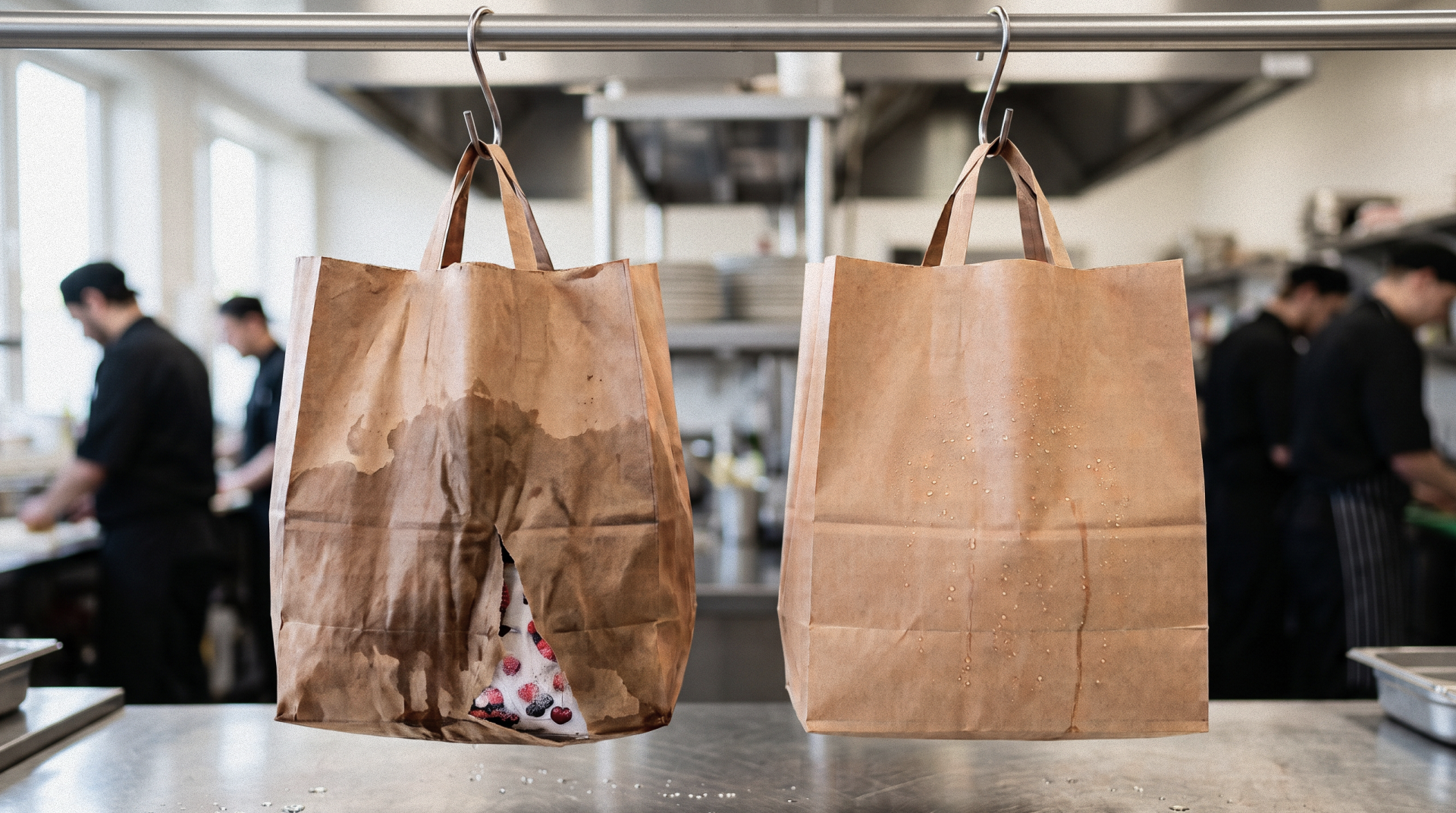

The practical rule: size the bag for the wettest and heaviest thing it will ever carry, not for the typical load.
- For dry retail categories, paper at an appropriate basis weight (the weight of the paper stock, which is what actually determines load capacity) with reinforced handles.
- For wet, greasy, chilled, or condensation-prone contents, a treated paper grade or plastic. Specifying untreated paper for hot food or cold beverages is a common and costly error, expensive out of proportion to the saving because it fails in front of the customer.
- For food contact specifically, the coating and ink also have to clear food-safety requirements, which we cover in our guide to food packaging safety standards.
A key caveat remains: paper's advantage on perceived quality also depends on the bag working. The Sustainability, 2026 review that identified paper's premium quality perception explicitly highlighted functionality and hygiene as strict prerequisites. Consequently, any bag that suffers structural failure loses its premium appeal, regardless of the substrate used.
Which Looks and Prints Better: Paper or Plastic Bags?
At a glance. Paper, on the shelf and on the press. Only paper takes the finishes buyers read as premium.
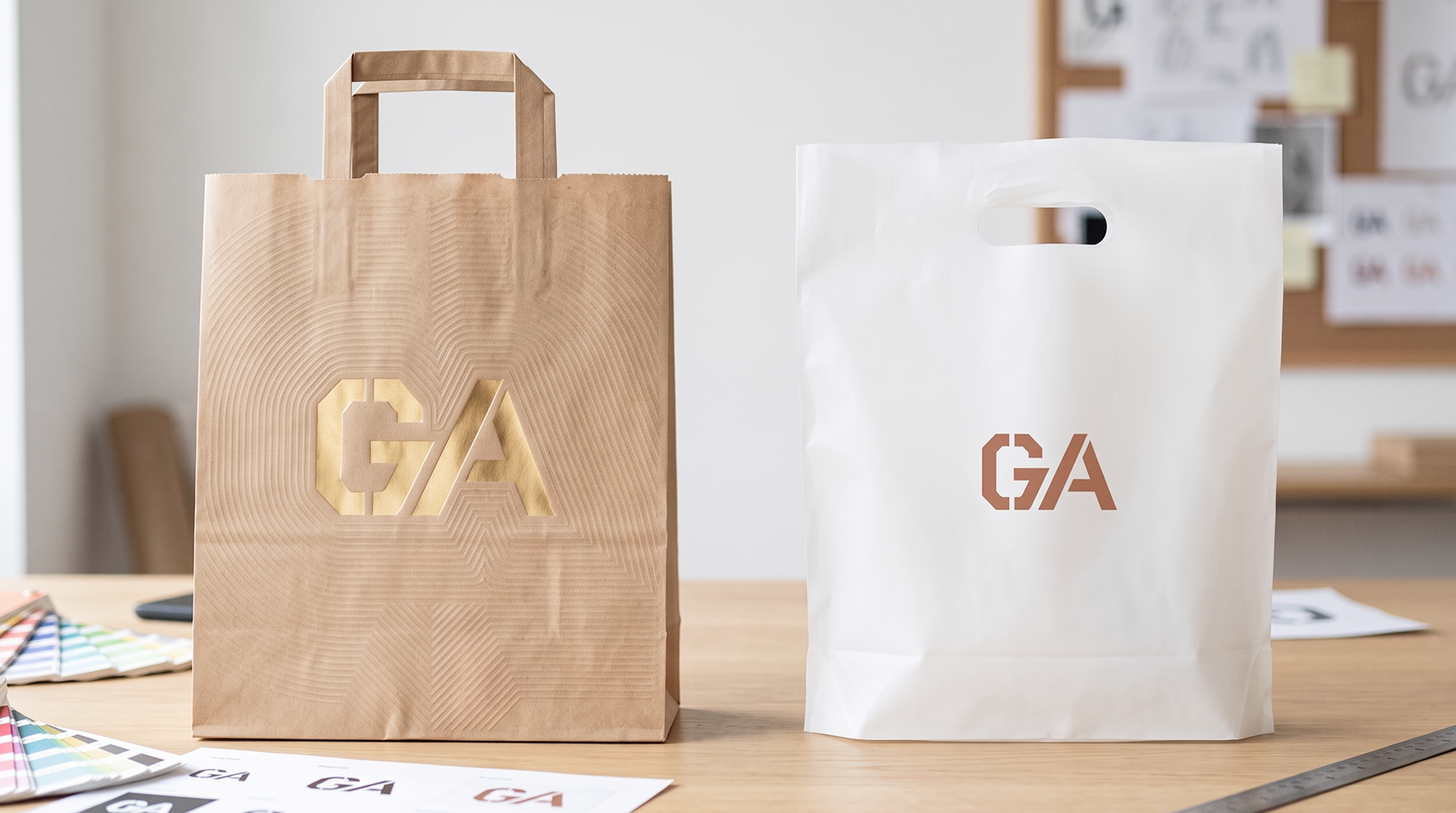
Paper packaging enhances perceived product quality, particularly for products associated with health and naturalness, while plastic tends to evoke negative associations even when it is recycled. That comes from a systematic literature review of 78 peer-reviewed studies published between 2019 and 2025 (Sustainability, 2026). The review attaches a qualification worth carrying: in premium segments where product visibility affects how quality is judged, transparency can outweigh the substrate. Where the customer needs to see the product, a clear bag may serve the brand better than an opaque paper one.
On the press, paper accepts high-quality offset and flexographic printing, plus the finishing that signals consideration: foil stamping, matte lamination, soft-touch coating, and embossing. Plastic is constrained on both process and finish range, which is why plastic bags carry a mark and paper bags carry a design.
How Do Paper and Plastic Bags Compare on Cost?
At a glance. Lightweight plastic has the lower unit cost. Paper costs more per bag and does a second job. Judge it on total packaging cost, not unit price.
Bag cost is set by dimensions, basis weight or film gauge, handle construction, print coverage, finishing, and order volume. The useful frame is Total Cost of Ownership, which counts material, freight, storage, and the brand work the pack performs, rather than the number on the quote.
A printed paper bag does two jobs: it carries the product, and it carries the brand for as long as the customer keeps it. A lightweight plastic bag does the first job at lower cost and leaves the second alone. Whether that trade works is your calculation to make: at a $60 average transaction, a few cents of bag is a rounding error against the impression it creates; at a $6 transaction it is a real margin decision. Order volume moves the figure more than most buyers anticipate in both materials, which is why bag cost gets quoted against a specification. The same discipline applies across a packaging program, which we set out in 5 costly mistakes scaling brands make.
This is where paper earns its higher unit cost. A printed bag keeps working after the transaction closes, for the rest of that day and often for weeks afterwards in a kitchen or a closet. It is one of the few branded surfaces a customer carries voluntarily, and it keeps earning after the sale.
Which Bag Should Your Brand Use, Paper or Plastic?
At a glance. 5 applications cover most bag specifications. Match to the application, and where a business spans several, specify several bags.
Running one bag across every application produces the two failures every retailer has seen: a premium printed paper bag carrying a cold beverage, and a plain plastic bag carrying a high-value purchase.
What to Ask a Bag Supplier
At a glance. You do not need to become a materials engineer to specify a bag properly. You need to know what a supplier should be able to show you.
What to demand:
- A rated load capacity for the bag at the basis weight you are buying, in writing.
- A named test behind any strength claim, such as burst strength (ISO 2758 / TAPPI T 403) or wet tensile.
- A treated grade option for anything wet, greasy, or chilled, named by grade rather than described as "stronger."
- An approved first-run sample your reorders are formally checked against.
- Chain-of-custody certification for any sustainability claim, not the word "eco-friendly."
Questions worth asking:
- What load is this bag rated to, and how was that established?
- Which grade do you recommend for wet or greasy contents, and what does it do to recyclability?
- Is the paper FSC-certified or recycled, and can you produce the certificate?
- What does the finishing add to unit cost, and at what volume does it come down?
- If my order runs across more than one facility, what holds the color and construction the same?
Red flags: a strength claim with no test named; "food grade" asserted without a standard; a sustainability claim with no certificate behind it; a quote that cannot be broken down by stock, print, and finishing; and a supplier who cannot tell you what happens to the bag's recyclability once it is coated.
Are Paper or Plastic Bags Better for the Environment?
At a glance. Neither, outright. Reuse and disposal decide the outcome, and of the alternatives the Environment Agency assessed, paper has the lowest reuse threshold.
The reference comparison is the UK Environment Agency's life cycle assessment of supermarket carrier bags, which calculated how many reuses each alternative needs to match the global warming potential of one thin single-use plastic bag (Environment Agency, 2011). Paper needs about 3 reuses. A heavier plastic bag needs 4. A thick reusable polypropylene bag needs 11. A cotton tote needs 131. Those figures assume the single-use bag is thrown away after one trip; where it is reused as a bin liner the thresholds rise to 4, 5, 14, and 173.
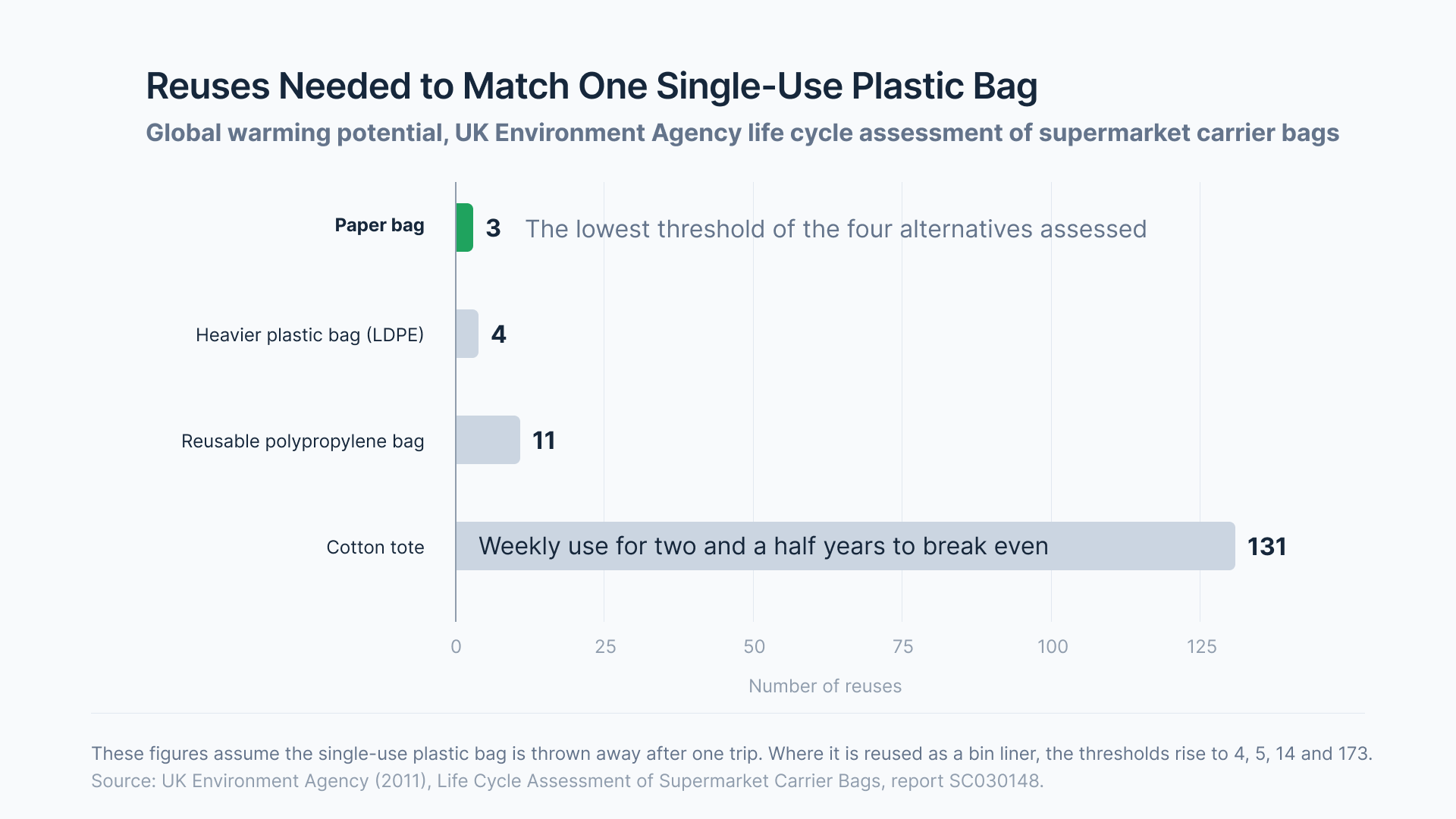
The second half of that finding is the more useful one. Three reuses is a low bar: a paper shopping bag that survives two weeks of grocery trips has already cleared it. The cotton tote that reads as the obviously responsible option has to be used weekly for two and a half years to break even. Durability is what makes a bag defensible, which argues for specifying a heavier paper bag than you think you need.
The figure that cuts against paper. The counterpoint is substantial. Boustead Consulting & Associates found that in single-use scenarios paper consumed 17.3 times more water than plastic and emitted roughly twice the greenhouse gases, as summarized in a Northern Ireland Assembly research briefing (NI Assembly, 2014). Paper is heavier to transport and more resource-intensive to make, so a paper bag that goes straight into the bin is the worse of the two.
Are all paper bags recyclable? Uncoated paper bags are widely recyclable and accepted in most curbside programs. Grease-coated, wax-coated, and laminated paper bags generally are not, because the coating cannot be separated from the fiber in a standard recycling stream. That is the trade-off attached to the specialty grades recommended earlier: a greaseproof bag solves the wet-strength problem and gives up curbside recyclability doing it. Plastic bags mostly require store drop-off, so both materials carry an end-of-life constraint.
Where extended producer responsibility (EPR) programs apply, that choice now carries a recurring fee. Eco-modulation prices each design decision by material and recyclability, so a laminated bag carries that cost every year it stays in the range. The mechanics are in our reference guide to extended producer responsibility for packaging. For sourcing, make the claim you can certify: our vetted manufacturing network holds Forest Stewardship Council (FSC) chain-of-custody certification, so FSC-certified and recycled stock trace to a certificate you can ask to see.
What Decides a Bag Specification
The throughline is that paper versus plastic is the wrong first question. The bag is specified by what goes in it, how far it travels, and how long you want the customer to keep it. Get those right and the material follows: paper where the contents are dry and the brand is doing work, treated paper or plastic where moisture is in play, a reusable format where the customer comes back.
The failures are consistent too. They come from specifying one bag for every application, buying on unit price without counting the brand work, and treating a strength claim as a fact when no test is named behind it. None of those is a material problem.
Tell us what your customers carry and how far, and we will specify the stock, basis weight, grade, and finish for it. Talk to our team about a bag specification review, and request a sample so you can handle the grade before you commit to a run.
Sources
- Consumer perception of paper vs plastic packaging (peer-reviewed systematic review): Kozik-Kołodziej, N. (2026), Sustainability 18(3) 1235.
- Reuse thresholds by bag type (government life cycle assessment): UK Environment Agency (2011), Life Cycle Assessment of Supermarket Carrier Bags, report SC030148.
- Plastic bags and film not accepted in household curbside recycling, with retail and grocery store drop-off as the route: US EPA, "How Do I Recycle: Common Recyclables".
- Paper water use and emissions in single-use scenarios (Boustead Consulting 2007, reported in a legislative research briefing; the briefing does not name who commissioned the Boustead study): Northern Ireland Assembly (2014), research briefing on carrier bags.
Frequently asked questions
Topics
Written by
5+ years in content strategy — building packaging case studies, guides, and blogs.