

Key takeaways
Reorder your packaging while the current pack still serves the brand and the cost curve. Redesign it when the annual saving clears the one-time cost of changing inside your planning horizon.
- 01Divide the one-time cost of a packaging change by the annual saving for your payback.
- 02Freight is usually the fastest payback, because right-sizing a box cuts billable weight.
- 03The August 2025 dimensional rounding change raised parcel billed weight 5% to 12%, per PARCEL Industry.
- 04Specifying box dimensions in whole inches avoids the rounding penalty entirely.
- 05Extended producer responsibility fees alone can justify a packaging redesign where programs apply.
Last updated October 2026.
When Should You Reorder Packaging, and When Should You Redesign It?
At a glance. Two numbers settle it: the one-time cost of changing, and the annual gain it produces. Divide the first by the second.
- The one-time cost of change is everything you pay once: tooling, dielines, plates, prototyping, transit testing, and the cost of running old and new stock in parallel.
- The annual gain is everything the new pack saves or earns every year after that: freight, material, storage, damage, and regulatory fees. Divide the first by the second and you have the payback period.
To evaluate any proposal, use that calculation as a threshold. Divide the one-time cost by your planning horizon in years and you get the minimum annual saving a redesign has to achieve to justify the change. If the projected saving falls short of that benchmark, reorder.
Judge the gain on total cost of ownership (TCO), which counts material, freight, storage, damage rates, and regulatory fees together, not on unit price. A redesign that raises the unit cost and removes 3 billable pounds from every parcel is a good redesign. Unit price alone cannot see that, which is the most common way this decision gets made wrongly.
When Is a Packaging Reorder the Right Call?
At a glance. Reorder while the pack still serves the brand and no warning sign has appeared. The reorder path carries almost none of the one-time cost a redesign does.
The reorder path is the low-cost one by construction. Tooling exists, dielines are cut, plates are made, and the minimum order quantity (MOQ) is already established, so a repeat carries almost none of the one-time cost that a redesign does. When the pack still serves the brand and none of the warning signs below has appeared, reorder and move on.
What a smart reorder does differently is re-check the inputs. The specification is fixed, but the numbers around it are not. Carrier rules change, freight lanes change, and your own volume changes, so the same box can quietly cost more this year than last.
On 18 August 2025, for one, FedEx and UPS both began rounding every fractional package dimension up to the next whole inch instead of to the nearest one when calculating dimensional weight (DIM), which added 5% to 12% to billed weight across typical parcel portfolios (PARCEL Industry). Nobody's box changed.


So a smart reorder is a short checklist, not a rubber stamp:
- Re-measure the pack and re-run the DIM calculation under the current rounding rule.
- Check every dimension against the next whole inch below it. A pack at 12.4" is billed at 13", so that 0.4" is charged and delivers nothing.
- Re-quote freight at this year's volume and lanes, not last year's.
- Re-match the order to the facility and freight setup that fits it now, so the repeat is re-optimized instead of repeated.
- Consolidate the run with other SKUs where the substrate and process allow it.
- Check whether any of the 6 operational warning signs has appeared since the last order.
Consistency across runs is the other half of a reorder, and it is governed separately: see how to keep packaging color and quality consistent as you scale.
What Are the Operational Warning Signs That a Packaging Redesign Will Pay Back?
At a glance. There are 6, and every one of them is visible in numbers you already hold or on your own shelf. Treat the list as a gate rather than a wish list.
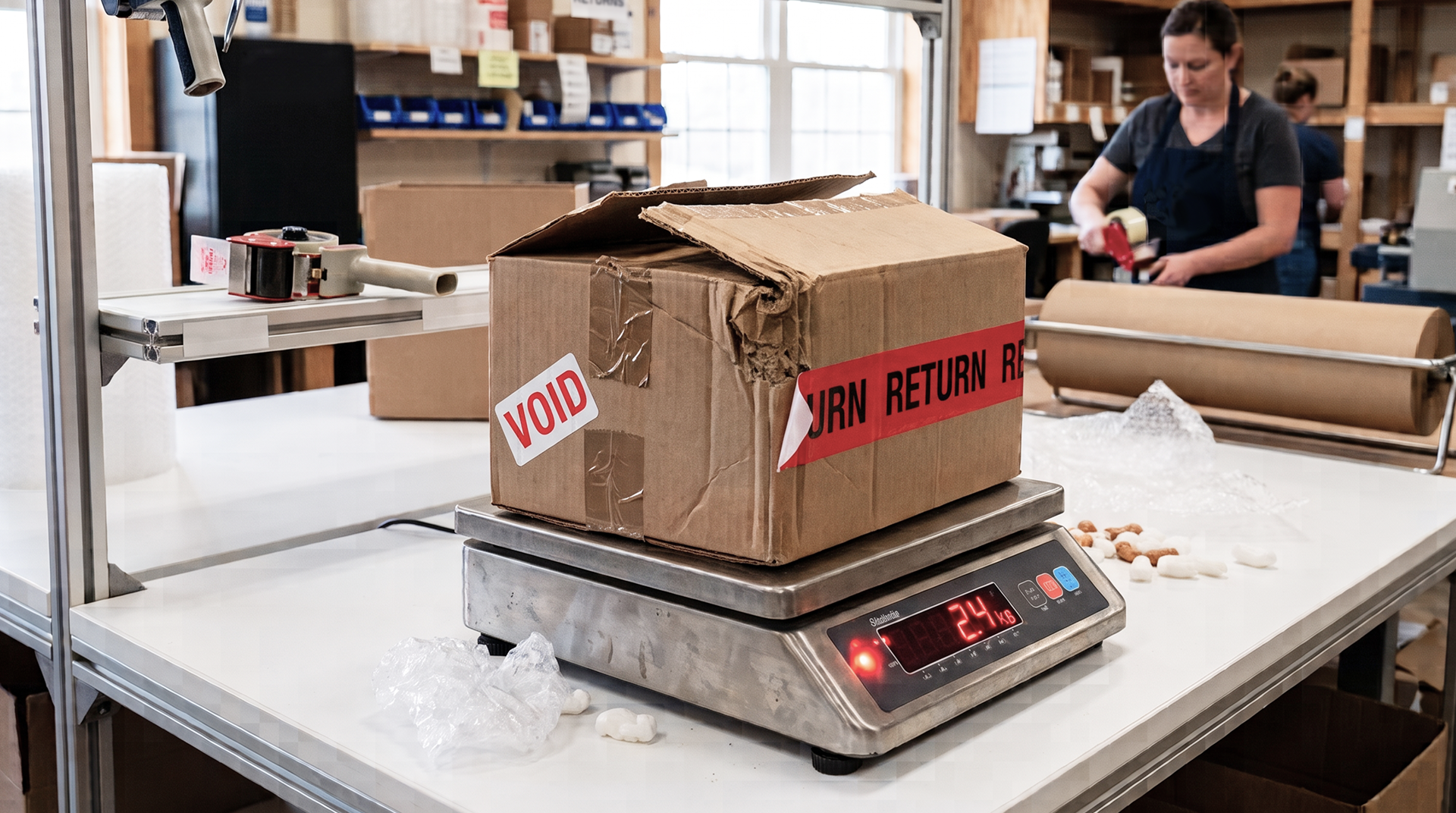
- Freight and dimensional weight. Your billable weight is running above your actual weight, which means the carrier is charging you for volume the product does not use. Compare the two on a recent invoice; the gap is the symptom.
- EPR and eco-modulation fees. Packaging extended producer responsibility (EPR) is law in 7 US states, and fees are set by material weight and recyclability, so a hard-to-recycle pack carries a charge every year it stays in the range. Check your exposure state by state before assuming it applies to you: as of September 2026 only Oregon and Colorado are invoicing regular program fees, California has invoiced a one-off early fee ahead of its 2027 program, and the remaining 4 states start between 2028 and 2030.
- Rising damage and returns. A pack that fails in transit is paying twice, in replacement and in the customer relationship. Damage rates trending up are a structural signal, not a carrier problem.
- A rebrand, a new channel, or a design direction you want to follow. Retail, marketplace, and subscription channels each impose their own requirements, and a pack built for one rarely satisfies another without change. A shift in what the category looks like counts too, which is why the 2026 packaging design trends are worth reading as warning signs in their own right before you commit to one.
- SKU proliferation. Count your active dielines. If the number has grown faster than your product line, you are carrying tooling and a separate MOQ for packs that differ by a few millimeters.
- Tariff and supply-concentration risk. A specification only one region can produce is a single point of failure. The signal is concentration, not price: check how many of your facilities could actually run this pack.
What Does a Packaging Redesign Actually Cost?
At a glance. More than the tooling quote. There are 6 one-time costs in the real figure, and every one you leave out shortens the payback on paper without shortening it in fact.
Ask for all 6 as a single figure before you divide by anything. Tooling and plates come off the quote, the reset MOQ off the order terms, and prototyping and testing off the production schedule.
- New tooling and dielines. A structural change means a new die, cut to the new dimensions and sized to the press that will run it.
- Printing plates. Any artwork or dimension change means new plates on an offset or flexographic run. Digital printing avoids plates entirely, which changes the economics of small runs. See our guides to offset and digital printing.
- A reset MOQ. A new specification starts a new minimum order quantity, so you may be committing to more units than your reorder cadence would have required.
- Prototyping and transit testing. A redesign that has not been transit-tested is a guess. This is a real cost and a non-negotiable one.
- Running old and new stock in parallel. You will hold two specifications for a period, which carries storage cost and the risk of a fragmented shelf presence.
- Launch timing. A changeover in peak season costs more than the same changeover in a quiet quarter, because errors are more expensive when volume is high.
The parallel-stock and launch-timing costs come from your own operations, so nobody will hand them to you. Leave those last two out and a 30-month payback can present as a 10-month one, which is how marginal redesigns get approved.
How Do You Run the Payback Math on a Packaging Redesign?
At a glance. One division, run on 3 worked cases. Two clear the threshold and the third does not, and the third fails for the reason most proposals fail.
Case 1: the right-size payback, worked from the DIM formula
This is the most common redesign that pays for itself quickly, and the whole calculation comes out of the carrier's own arithmetic. For anything light relative to its size, carriers bill on volume instead of weight: multiply the 3 dimensions in inches, divide by 139, and that is your billable weight in pounds. Since 18 August 2025 each fractional dimension is rounded up to the next whole inch before that multiplication, which is why a box nobody has touched can cost more than it did the year before.
A direct-to-consumer (DTC) brand ships about 200,000 parcels a year in a box measuring 12.4" x 10.2" x 5.6" (L x W x H), a size too large for the product.
Two effects are worth separating. The rounding rule alone moved this box from 6 billable pounds to 7 without anyone changing it, a 17% increase. That runs higher than the 5% to 12% PARCEL Industry measured across typical portfolios, because all 3 of this box's dimensions are fractional and each one rounds up. Right-sizing then removes 3 more pounds on top.
The first effect points at a design rule most specifications do not yet carry: dimension the box in whole inches. A pack at 12.4" is billed at 13", so the 0.4" is charged and delivers nothing, and bringing a dimension under the next whole inch is free volume on every parcel you ship.
600,000 pounds a year is 50,000 a month. Apply your own cost per billable pound to convert that into dollars, and at any realistic rate a new dieline and die costing a few thousand dollars is recovered inside the first month.
Verdict: redesign. At this parcel volume a freight-driven right-size is close to automatic, and the reason is that nothing in the calculation is an estimate except the box you choose.
Case 2: EPR fees as a warning sign that carries a redesign on its own
A newer line item, and one that can carry a redesign without any freight or material saving attached. EPR fees are charged per pound by material category, and the categories are priced by how recoverable the material is. A brand placing about 150,000 lb of flexible packaging a year on the market in Oregon can read its exposure straight off the published schedule.
The move that pays here is not a change of format but a change of structure: a multi-layer laminate replaced by a mono-material film, which the same schedule prices at less than half the rate.
Both rates are real categories from Oregon's 2026 producer fee schedule, which runs to roughly 60 of them. Both are base fees, charged on weight by category. Eco-modulation then adjusts each one up or down on the specific design, and it favors the recyclable format, so the real gap runs even wider than $88,500. Against a tooling bill of around $6,000, that is a payback in under a month on avoided fees alone, before any freight or material saving is counted.
Verdict: redesign. One condition decides whether this saving is available at all. A mono-material film has to clear the product's own barrier and shelf-life specification, and where it cannot, the fee gap is not accessible at any payback. Test that first, then the arithmetic. The mechanics, the full category list, and the reporting obligations are in our reference guide to extended producer responsibility for packaging.
Case 3: the change that does not clear the threshold
Not every proposal survives the division, and the ones that fail tend to fail the same way: a real saving that is simply too small against a real cost.
A brand reordering 40,000 units a year is offered a structural change that takes $0.05 off each unit, worth $2,000 a year. The one-time cost is $9,000, covering a new die, plates, prototyping and transit testing, and a short parallel-stock period. The payback is 4.5 years. Against a 3-year planning horizon that fails, and it fails at every horizon shorter than 4.5 years. The arithmetic was never in question; the annual gain was too small to carry the cost.
Verdict: reorder, and re-check at the next order, because volume is the input most likely to move. At 200,000 units the same change saves $10,000 a year and pays back in about 11 months, on identical tooling. Nothing about the design got better in between.
Where Do the Savings Come From in a Packaging Redesign?
At a glance. There are 6 places to take cost out, and between them they cover most of where packaging cost actually sits. Right-sizing moves freight and the rest move material, but the two that get overlooked are sheet yield and specification consolidation.
- Right-sizing to cut dimensional weight. Cut the cubic volume to the product plus the protection it needs, and billable weight falls by the arithmetic in Case 1. The fastest payback on this list.
- Material downgauge or substitution. Move to a lighter board grade or a different substrate that still clears the performance spec: double-wall 275# test down to single-wall 200#, for instance, where the product weight allows it. Never below the spec. SAVE International, which maintains the value methodology standard, defines value as "the reliable performance of functions to meet customer needs at the lowest overall cost," and reliable performance comes before cost in that sentence, which is the order a downgauge has to respect.
- Structural or format change. A different structure can deliver the same protection with less material: a die-cut fitted insert in place of loose fill, or a self-locking base in place of a glued one.
- Insert and void-fill optimization. A fitted insert usually protects better in less space than generic fill, which takes cost out of material, DIM weight, and EPR fees at the same time.
- Specification consolidation. One modular structure sized to a range, so several SKUs share a die and a single order quantity. The saving is the tooling you stop paying for and the volume break you reach sooner.
- Nearshoring or re-sourcing. Re-specifying so more than one region can make the pack, then producing closer to the destination market. Trades unit cost against freight and tariff exposure, so judge it on landed cost.
Sheet yield: the saving that hides inside the dieline
Right-sizing is usually discussed as a freight saving, and it is also a material one. A dieline is cut from a standard sheet, and how efficiently the shape nests on that sheet decides how many blanks you get from it. Optimize the layout and more blanks fit on the same substrate.
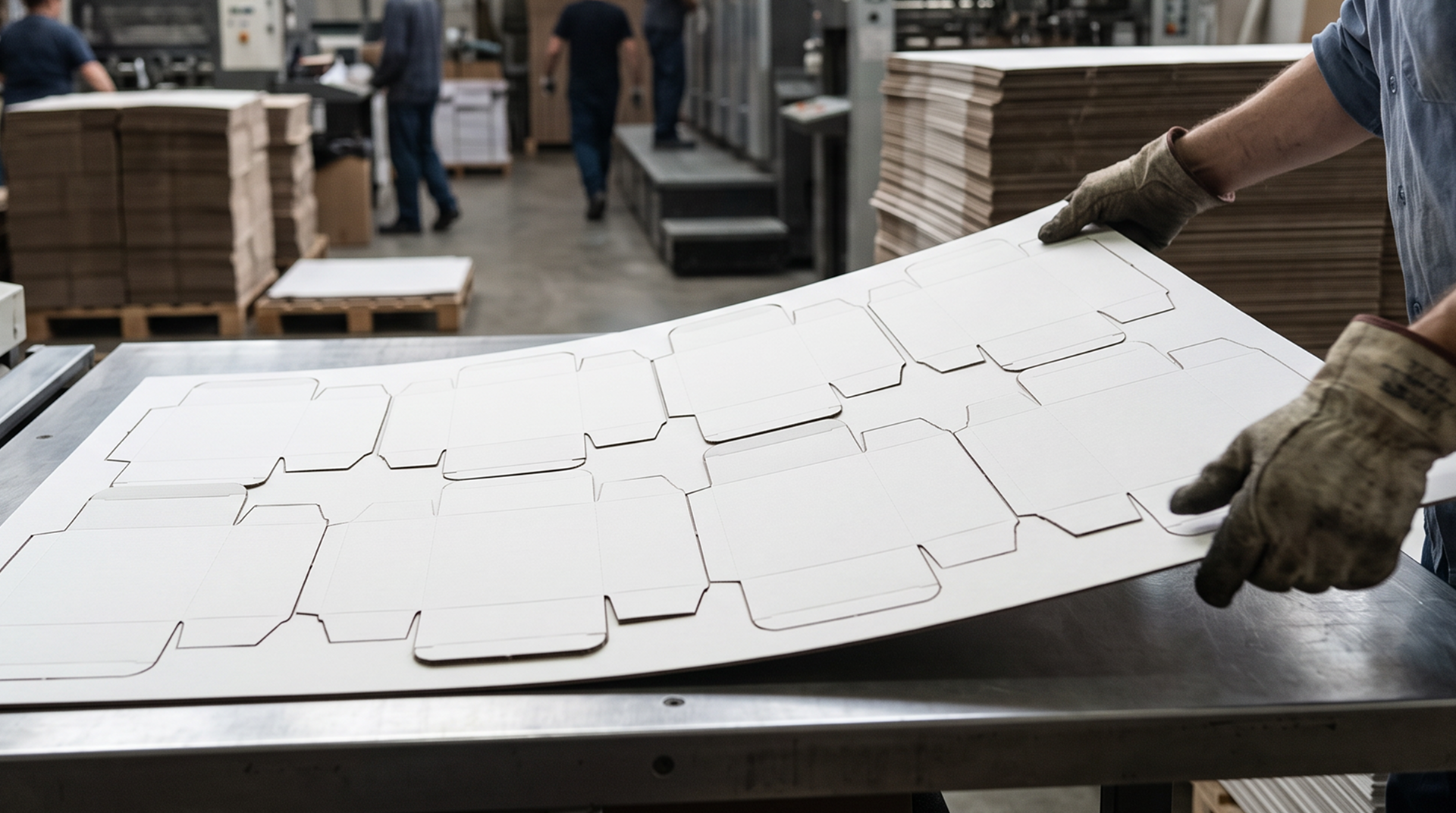
A 20% cut in board with no change in grade and no change in performance. It is worth asking for the nesting layout when you review a dieline, because this saving is invisible on a specification sheet and it compounds on every run. This decision sits inside the Scaling stage of packaging strategy by growth stage, and the cost errors that make it harder are in 5 costly mistakes scaling brands make.
Where PakFactory Fits
Reorder or redesign is a packaging procurement decision, and we run the arithmetic with you instead of handing over a quote. That means the one-time cost against the annualized gain on your freight, volume, and fee exposure; a sourcing re-match on every reorder, so a repeat is re-optimized instead of repeated; and packaging value engineering on the alternative when a redesign clears the threshold. Because we hold your tooling and run the program end to end, the next payback is a number you can quantify rather than estimate.
Bring your current pack, your parcel volume, and your freight average. We will run the reorder-versus-redesign math on your numbers. Talk to our team about a packaging value-engineering and sourcing review, and request a sample of the alternative before you commit to a run.
Sources
- Dimensional-weight rounding change and its measured effect on billed weight (both carriers effective 18 August 2025; DIM divisor 139): Rickey DuBois, "One Year Later: How the Dimensional Rounding Change Has Impacted the Parcel Industry", PARCEL Industry, March/April 2026.
- Oregon 2026 producer base-fee rates by material category (primary source, roughly 60 categories): Circular Action Alliance, 2026 Oregon Producer Fee Schedule.
- US packaging EPR status by state, including which states are invoicing as of September 2026: EPR Atlas, EPR Fees by State.
- Definition of value: SAVE International, Value Methodology.
Frequently asked questions
Written by
5+ years in content strategy — building packaging case studies, guides, and blogs.